
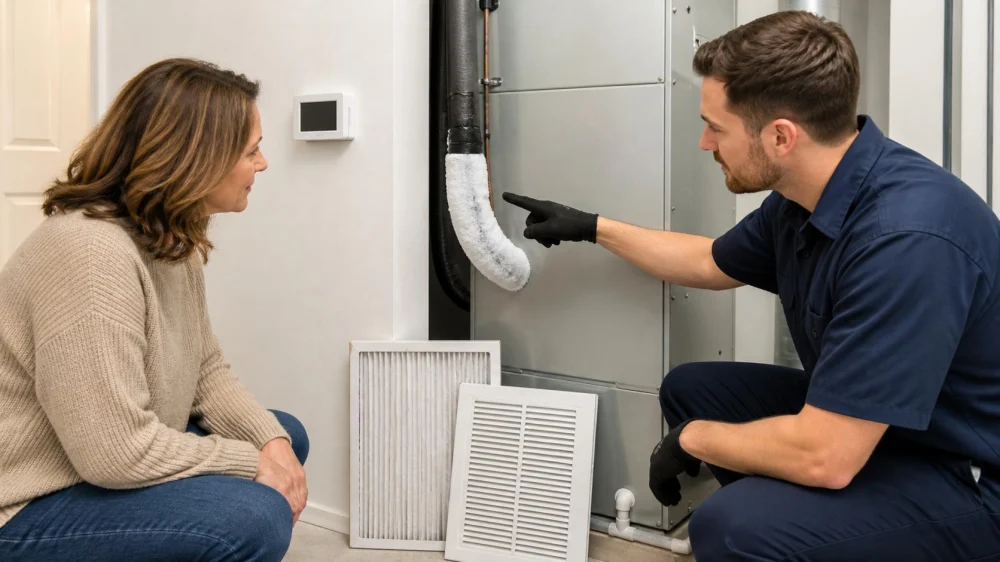
Ice on Your AC: Turn Off Cooling and Check Airflow First
Table of contents
Quick answer
If you see ice on the indoor coil, refrigerant line, or outdoor unit during cooling weather, switch the thermostat from cooling to off and protect the area from meltwater. Check only the filter, open supply registers, and unobstructed return grilles. Do not chip the ice or open equipment. Arrange HVAC service if airflow is not clearly restored or icing returns.
Douglas Taylor AC & Refrigeration
6560 116th Ave N A, Largo, FL 33773, USA
Why ice forms
The indoor evaporator coil must receive enough warm household air while refrigerant absorbs heat. When coil temperature falls below freezing, moisture can freeze on it. Common contributors include a dirty or restrictive filter, blocked airflow, blower trouble, dirty coil, thermostat or control problems, or improper refrigerant charge caused by a leak or service issue.
Ice itself reduces airflow further, so continued operation can make the freeze-up worse and send water outside the drain system when it melts.
Safe first steps
- Stop cooling. Set the thermostat mode to off. Do not repeatedly restart to test it.
- Control water. Move belongings, place a shallow pan where safe, and watch ceilings or drain pans for overflow.
- Check the filter. Replace it only with the correct size and airflow direction if it is visibly dirty or overdue.
- Restore ordinary airflow. Open supply registers and clear furniture, rugs, boxes, or curtains from return grilles.
- Let ice melt naturally. Use fan-only mode only if the system manual or HVAC professional says it is appropriate and there is no electrical or water hazard.
- Call for service. Recurrent ice, weak airflow, unusual sounds, or water near electrical components needs professional diagnosis.
What to record for service
- where ice first appeared and how far it spread;
- thermostat mode, setting, and indoor temperature;
- filter size, type, and last replacement date;
- whether airflow is weak at all rooms or only some;
- recent service, refrigerant work, power interruptions, or construction dust;
- photos taken without removing panels or reaching into equipment;
- water location, odour, noise, and how long the system ran before icing.
Avoid damaging shortcuts
Do not scrape, hammer, or heat the coil with a hair dryer, heat gun, or open flame. Do not pour hot water on electrical equipment. Never bypass a safety switch, run without a filter, or add refrigerant yourself. Refrigerant systems require trained, EPA-certified handling.
If there is smoke, burning odour, arcing, or water reaching electrical parts, shut the system down only from a safe control and call emergency or qualified service as appropriate.
Limitations
A frozen line does not identify the root cause, and a clean filter does not rule out airflow or refrigerant problems. Equipment layouts differ, including heat pumps and ductless systems. Thaw time varies with ice thickness and indoor conditions. A technician may need electrical, airflow, temperature, and refrigerant measurements.
FAQ
Can I run cooling after the ice disappears?
If a clearly blocked filter or grille was corrected, ask the manufacturer or service company about a monitored restart. Recurrent icing needs service.
Will a lower thermostat setting help?
No. It can extend runtime and worsen freezing.
Is condensation on the large line normal?
Cool-line condensation can be normal, but solid ice, spreading frost, or dripping outside the intended drain path is not.
Should I open the coil cabinet?
No. Leave panels, refrigerant tubing, blower components, and electrical sections to a qualified technician.
Sources and evidence notes
- U.S. Department of Energy HVAC controls material — airflow verification and clogged-filter/frozen-coil relationship.
- EPA: Homeowners and Consumers Refrigerant FAQ — certified refrigerant service and leak repair.
Next steps
Turn cooling off, protect the area from meltwater, check the correct filter and visible grilles, and photograph the icing safely. Schedule service if the cause is not obvious, the system has an electrical or water hazard, or ice returns after one monitored correction.
 Peace Heating and Air5.0 (81 reviews)
 All Pro Mechanical of North Atlanta5.0 (2 reviews)
 TemperaturePro5.0 (161 reviews)
 Hearts Heating and Air Conditioning4.0 (16 reviews)
 C&C Air Services, LLC4.0 (14 reviews)
 Etowah Heating & Cooling4.0 (31 reviews)
 Common Mistakes When Fixing Your AC Unit and How to Avoid Them
 How to Test Your Air Conditioner’s Capacitor and Fix It If Needed
 The Best Ways to Maintain Your Air Conditioner During Summer
 How to Repair a Faulty Air Conditioner Compressor: A Step-by-Step Guide
 How to Fix a Leaking Drain Line in Your Air Conditioner | Ac Fix
 The Complete Guide to AC Fan and Motor Repair