
AC Vent Grille Dust: Clean Without Duct Damage
Table of contents
Quick answer
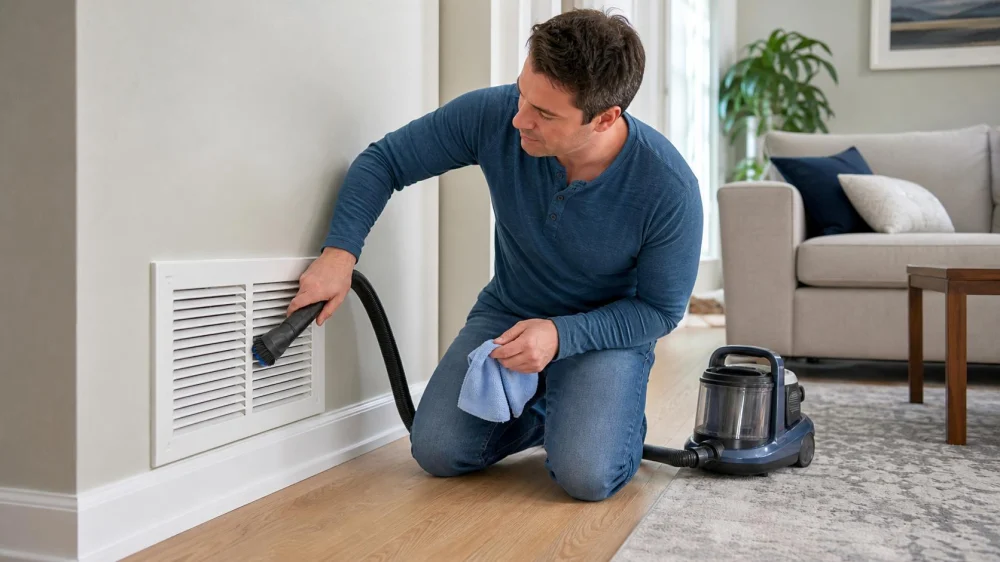
Turn the HVAC system off, vacuum loose dust from the vent grille with a soft brush attachment, then wipe the exterior with a barely damp microfiber cloth and dry it. Keep liquid, sprays, tools, and vacuum hoses out of the duct. Do not remove a high, painted-over, wired, rusted, or damaged grille. Rapid return of dust, moisture, odor, or dark growth needs diagnosis—not stronger scrubbing.
Clint Johnson HVAC, Inc.
North WilkesboroWilkes CountyNorth Carolina
3048 Statesville Rd, North Wilkesboro, NC 28659, USA
Identify the grille and access
Supply registers deliver conditioned air and often have adjustable louvers. Return grilles pull room air back toward the system and may be larger or contain a filter. Either can collect ordinary household dust, but the access and maintenance procedure may differ.
- Look for an airflow lever without forcing it.
- Check whether the grille opens with a simple latch for filter access.
- Note screws, paint seals, rust, cracks, loose edges, or nearby wiring.
- Confirm the surface can be reached from the floor without stretching.
- Photograph louver direction and any filter position before touching it.
Leave ceiling grilles, tall wall vents, floor registers on unstable surfaces, and any cover connected to powered controls for a professional when safe access is uncertain.
CE (Carrier Enterprise)
FlorenceFlorence CountySouth Carolina
1505 N Schlitz Dr, Florence, SC 29501, USA
Prepare the system and room
Set the thermostat so the blower will not start and wait until airflow stops. Move furniture and rugs far enough away to work without tripping. Place a washable cloth or disposable sheet below the grille to catch loose debris.
Use a vacuum with a clean soft brush, dry microfiber cloths, and a small amount of plain water if the grille finish allows it. Avoid aerosol sprays, fragrance, bleach, solvent, abrasive pads, and mixtures that can enter the duct or damage paint. Wear ordinary eye protection if debris could fall from a low overhead surface.
Vacuum and wipe the surface
- Hold the grille steady without bending the slats.
- Use low or moderate suction and brush from the top downward.
- Vacuum the frame, louver faces, and accessible edge only.
- Wipe with a barely damp cloth; liquid should not drip or run.
- Use a dry cloth to remove remaining moisture.
- Restore adjustable louvers to their original position.
Do not push the brush, cloth, ruler, or hose into the duct. Interior duct liners, dampers, seals, and wiring can be damaged or displaced. Surface cleaning is not a substitute for duct inspection.
Know when not to remove the grille
A simple floor register may lift out, and a filter grille may open on a designed hinge. Follow the equipment instructions. Do not remove screws simply because dust is visible behind the cover.
Stop when the grille is painted to the wall, caulked, corroded, loose in drywall, connected to a damper cable or control, or located where a ladder would be needed. Removing it can tear paint, damage the boot connection, drop hardware into the duct, or create a sharp opening.
If a removable cover is washed, follow its manufacturer instructions and reinstall it only when completely dry. Never wash a filter unless it is explicitly reusable.
If dust returns quickly
A thin dust line can result from room air movement and ordinary particles. Heavy return soon after cleaning deserves a broader check. Confirm the correct filter is installed, fits properly, points in the correct airflow direction, and is changed on the schedule appropriate for the system and household.
Look for renovation dust, open construction areas, crumbling material around the grille, damaged seals, candles or combustion particles, and furniture blocking airflow. Do not label dark material as mold from a photograph or wipe test. Moisture source and material identification require appropriate evaluation.
When to call an HVAC technician
Arrange professional service if you see water or active condensation, rust that weakens the grille, damaged duct material, a disconnected boot, unusual odor, visible debris blowing from several vents, weak airflow, repeated filter collapse, or dust that returns unusually fast across the system.
Stop the system and seek prompt help for smoke, burning odor, sparking, exposed wiring, or water near electrical equipment. Do not reach into a duct to retrieve an object while the system could start.
Cleaning checklist
- Identify supply, return, filter access, and adjustable parts.
- Turn the system off and wait for the blower to stop.
- Work from stable floor-level access.
- Vacuum with a clean soft brush and controlled suction.
- Wipe the exterior with a barely damp cloth and dry it.
- Keep liquid, sprays, and tools out of the duct.
- Restore louvers and filter position correctly.
- Record moisture, odor, damage, or fast dust return for a technician.
Limitations
This guide covers accessible exterior grille cleaning. It does not cover duct cleaning, coil or blower service, disinfection, mold assessment, asbestos or lead disturbance, pest contamination, smoke cleanup, or repair of damaged ducts and boots. HVAC designs and grille finishes vary, so equipment and manufacturer instructions take priority.
Frequently asked questions
Can I spray cleaner directly on an AC vent?
No. Spray can enter the duct, affect finishes, and leave residue. Apply only an approved product to a cloth when instructions permit, and keep the cloth barely damp.
Should I vacuum inside the duct?
Do not insert a household vacuum hose into the duct. It can damage liners or components and cannot provide a complete inspection or cleaning.
Does black dust mean mold?
Not necessarily. Colour alone cannot identify a substance. Record moisture, location, odor, and recurrence, then ask a qualified professional to evaluate the cause.
Can I close a dusty supply vent?
Clean it and return adjustable louvers to their intended position. Closing multiple registers can affect system airflow; ask an HVAC technician before changing the balance.
How often should vent grilles be cleaned?
There is no single interval for every home. Inspect during routine cleaning and address visible surface dust without waiting for a heavy buildup. Rapid recurrence needs diagnosis.
Next steps
Add accessible grille inspection to regular filter changes. Photograph a problem before cleaning, use the soft-brush and barely damp cloth method, then check the same grille after normal operation. If moisture, odor, damage, or unusual buildup returns, share the before-and-after notes with an HVAC technician.

 AC Crew5.0 (118 reviews)
 Sun City Mechanical5.0 (5 reviews)
 Price Refrigeration & A/C Service4.0 (26 reviews)
 Superior Service Heating And Cooling LLC5.0 (62 reviews)
 Jackson Services4.0 (939 reviews)
 USA Air Inc.4.0 (21 reviews)
 Why Your Air Conditioner is Not Cooling and How to Repair It
 How Long Should It Take to Fix an Air Conditioner? – Timely Repairs Explained
 How to Handle an Air Conditioner That Is Not Cooling Properly
 Pros and Cons of Trying to Replace Your Air Conditioning on Your Own
 DIY vs Professional AC Repair: How to Decide Who Can Fix Your AC
 How to Repair an Air Conditioner with a Broken Duct System