
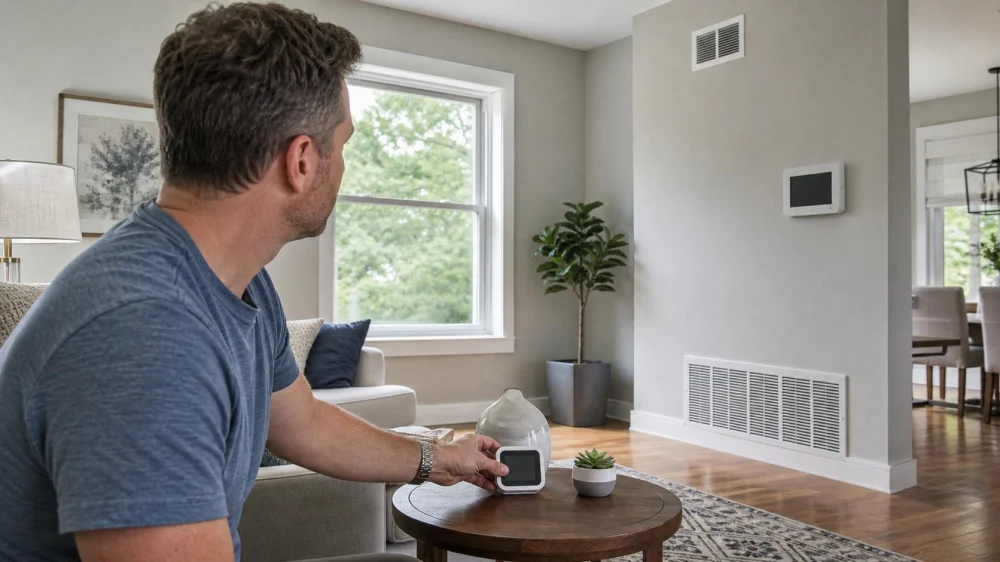
AC Running but Indoor Humidity Is High: What to Check
On this page
- Quick answer
- Measure humidity before diagnosing
- Check household moisture sources
- Review thermostat and fan settings
- Check accessible airflow conditions
- Look for drainage and water clues
- Record the AC run pattern
- Understand professional diagnostic areas
- Use temporary moisture controls carefully
- Prepare for an HVAC visit
- Safety and health boundaries
- High-humidity checklist
- Frequently asked questions
- Sources and evidence notes
- Next steps
Quick answer
If the AC runs but the home stays humid, verify the reading with a separate hygrometer, note outdoor conditions, close obvious moisture sources, use the thermostat’s normal cooling mode, and check the filter, accessible vents, windows, exhaust fans, and visible drain area. Persistent humidity can involve airflow, drainage, controls, duct leakage, ventilation, refrigerant performance, or improper equipment sizing.
Do not add refrigerant, open equipment, change blower wiring, or clear a drain with high pressure. Those are professional diagnostic and repair tasks. High humidity may also come from plumbing, roof, foundation, or envelope moisture rather than the air conditioner alone.
Measure humidity before diagnosing
Comfort words such as “sticky” and “clammy” are useful symptoms, but they do not measure relative humidity. Use a separate digital humidity meter in addition to any thermostat display. Place it in the occupied zone, away from a supply vent, exterior door, bathroom, kitchen steam, direct sun, or humidifier.
EPA recommends keeping indoor relative humidity below 60% and ideally between 30% and 50%, when possible. That is general indoor-air guidance, not a promise that every home will hold the same number during every weather event.
Record readings at the same locations and times for several days:
- indoor temperature and relative humidity;
- outdoor temperature, humidity, rain, and dew point if available;
- thermostat target and mode;
- whether the compressor and indoor fan appear to be running;
- cooking, showers, laundry, mopping, or many occupants;
- open windows, doors, or ventilation equipment;
- which rooms feel different.
Check household moisture sources
An air conditioner removes moisture while cooling, but it cannot compensate efficiently for an uncontrolled water or vapor source. Walk through the home before blaming the equipment.
Check for:
- a bathroom exhaust fan that is off, blocked, or venting into an attic;
- a clothes dryer that is not venting outdoors properly;
- long cooking or boiling without kitchen exhaust;
- a whole-home humidifier still operating in summer;
- open windows or doors while outdoor air is humid;
- aquariums, indoor drying racks, many plants, or frequent wet cleaning;
- plumbing leaks under sinks, behind toilets, or near appliances;
- roof, wall, basement, crawlspace, or foundation water entry;
- wet carpet, drywall, insulation, or stored items after a leak;
- an unvented combustion appliance adding moisture.
Address active water entry promptly. EPA emphasizes moisture control and drying wet materials quickly. An HVAC adjustment should not be used to hide a plumbing, drainage, or building leak.

Review thermostat and fan settings
Use cooling mode rather than fan-only mode. On many systems, setting the fan to “on” makes the indoor blower run after the compressor stops. Air moving across a wet coil may return some moisture to the home, depending on the equipment and controls. “Auto” is often the normal setting for dehumidification, but follow the manufacturer’s instructions for the actual system.
Check for special modes such as dehumidify, dry, circulate, ventilation, away, energy-saving, or humidity control. Do not assume the name explains exactly what the mode does. Read the thermostat and equipment manuals, including how a variable-speed system manages humidity.
A very low setpoint is not a good diagnostic. It may make the system run for a long time, overcool spaces, waste energy, or conceal control problems. Use the normal comfort target and record how the system cycles.
Check accessible airflow conditions
Airflow through the indoor coil influences both cooling and moisture removal. Homeowners can check basic accessible items without opening the system.
- Inspect the filter according to the equipment instructions and replace it with the specified size and appropriate type when due.
- Confirm the filter airflow arrow points in the required direction.
- Make sure return grilles are not blocked by furniture, boxes, rugs, or dust buildup.
- Open supply registers that are intended to remain open; widespread closing can disrupt system airflow.
- Notice whether airflow is unusually weak, strong, noisy, or different across rooms.
- Check that interior doors and transfer paths allow return air to move as designed.
Do not install an extra-restrictive filter merely to solve humidity, and do not run the system without its specified filter. A technician can measure static pressure, airflow, blower settings, coil temperature, and duct performance.
If frost or ice is visible on an accessible refrigerant line or cabinet, turn cooling off and call for service. Do not chip ice, apply heat, or continue running the compressor to test it.
Look for drainage and water clues
Moisture removed from indoor air normally condenses on the evaporator coil and drains away. A blocked, disconnected, poorly sloped, or overflowing drain can create water damage and may shut down systems with a safety switch.
Without opening equipment, look for water around the air handler or furnace, a full auxiliary pan, staining below equipment, damp insulation, algae at an accessible termination, or a recurring float-switch message. Turn cooling off and call for service if water is near electrical components or overflowing into the home.
EPA advises keeping AC drip pans clean and drain lines unobstructed and flowing. The safe cleaning method depends on the system. Do not pour chemicals, use compressed gas, or connect high-pressure equipment unless the manufacturer permits it and you are qualified.
Record the AC run pattern
Humidity removal requires the coil to become cold and operate long enough for water to condense and drain. Record approximate on and off times for several cycles during stable weather. A smart thermostat history can help, but confirm that the history represents compressor operation rather than only fan calls.
Short cycles may occur because the system satisfies temperature quickly, is oversized, has a control or sensor issue, experiences airflow trouble, or is interrupted by a protection device. Long continuous operation with poor humidity control points to a different set of questions.
ENERGY STAR notes that oversized equipment may cycle too frequently and reduce comfort; for room air conditioners, an oversized unit can cool before it removes enough humidity. Proper sizing depends on the home’s actual characteristics, not a simple square-foot rule.
Understand professional diagnostic areas
A qualified HVAC professional may assess:
- temperature and humidity sensor accuracy and location;
- thermostat setup, staging, fan overrun, and dehumidification controls;
- airflow, static pressure, filter selection, blower speed, and coil condition;
- condensate pan, trap, drain, float switch, and termination;
- refrigerant circuit performance and charge using approved procedures;
- duct leakage, insulation, return paths, and pressure imbalances;
- outdoor-air ventilation rate and control;
- equipment capacity, latent performance, and sizing calculations;
- building envelope leaks and non-HVAC moisture sources;
- whether dedicated dehumidification is appropriate.
Do not request “a refrigerant top-off” as the diagnosis. Refrigerant is part of a sealed system, and low charge can indicate a leak or another problem. Proper testing and repair require qualified handling and compliance with applicable rules.
Use temporary moisture controls carefully
A portable dehumidifier can provide temporary support in an enclosed area when used according to the manufacturer’s directions. Choose a properly sized listed product, place it on a stable surface with clearance, clean its filter, and manage the bucket or approved drain safely.
Do not use an extension cord unless the manufacturer explicitly allows it. Keep the unit away from standing water and do not route a drain hose where it creates a leak or trip hazard. A portable unit adds heat to the room while removing moisture, so it is not a substitute for diagnosing a central problem.
Dry condensation on windows or hard surfaces and correct the cause. Porous materials that remain wet, visible mold, or a large water event may require qualified remediation rather than more cooling.
Prepare for an HVAC visit
Provide the technician with:
- humidity readings, device locations, and dates;
- indoor and outdoor conditions;
- thermostat mode, fan setting, schedules, and error messages;
- cycle timing or thermostat history;
- recent filter, thermostat, duct, insulation, or equipment changes;
- rooms with condensation, odors, or different comfort;
- water, drain, roof, plumbing, or crawlspace events;
- equipment model numbers and maintenance records.
Ask for measured findings, not only a proposed part. Useful results may include sensor comparison, airflow or static pressure, temperature split interpreted with humidity, condensate performance, control setup, and sizing or ventilation observations.
Safety and health boundaries
Stop the system and seek help for smoke, burning odor, sparks, repeated breaker trips, water near electrical equipment, ice buildup, loud mechanical distress, or severe leakage. Use emergency services for immediate danger.
Humidity can affect comfort and support mold growth, but a humidity reading does not diagnose a health condition or prove hidden mold. People with symptoms should consult a healthcare professional. Renters should report persistent moisture and equipment problems to the property manager in writing.
This article is general U.S. education. It does not replace product instructions, an HVAC diagnosis, a moisture investigation, mold assessment, electrical service, or local code requirements.
High-humidity checklist
- Verify humidity with a separate meter.
- Log indoor, outdoor, and thermostat conditions.
- Close humid outdoor air and control household moisture sources.
- Use cooling mode and review the fan setting.
- Check the specified filter and accessible vents.
- Look for water, drain overflow, or visible ice.
- Record cycle timing and room differences.
- Do not open equipment or add refrigerant.
- Use temporary dehumidification only as directed.
- Request measured professional findings.
Frequently asked questions
What indoor humidity is too high?
EPA advises keeping indoor relative humidity below 60% and ideally between 30% and 50%, when possible. Confirm the reading and consider local outdoor conditions and the building.
Should the thermostat fan be on or auto?
Many systems use auto for normal dehumidification, but equipment and controls differ. Follow the system manual and ask the installer how fan circulation and overrun are configured.
Can a dirty filter cause high humidity?
A restricted or unsuitable filter can affect airflow and system performance. Replace it as specified, but persistent humidity still deserves a full assessment.
Does high humidity mean the AC is oversized?
Oversizing is one possibility, especially with short cycling, but it is not the only cause. Controls, airflow, drainage, ventilation, moisture sources, ducts, and refrigerant performance also matter.
Will lowering the thermostat remove more humidity?
It may lengthen operation but can overcool the home and does not diagnose the cause. Use a normal setpoint and have persistent moisture control evaluated.
Do I need a whole-home dehumidifier?
Possibly, but first identify moisture sources and verify AC, ventilation, drainage, airflow, and sizing. A contractor can calculate the appropriate strategy.
Sources and evidence notes
- U.S. Environmental Protection Agency: Care for Your Air recommends indoor humidity below 60% and ideally between 30% and 50%.
- EPA: A Brief Guide to Mold, Moisture and Your Home covers moisture control, condensation, drip pans, drain lines, and prompt drying.
- ENERGY STAR: HVAC Quality Installation explains how sizing, airflow, and refrigerant performance affect comfort and dampness.
The checklist organizes official indoor-air and HVAC principles into safe observations. It cannot identify the cause without measurements and inspection.
Next steps
Place a separate humidity meter in a representative room and keep a three-day log of indoor readings, weather, thermostat settings, moisture activities, and cycle times. Correct obvious sources and filter or vent issues, then schedule HVAC service if humidity remains high or water, ice, abnormal cycling, or electrical symptoms appear.


 ATS Mechanical Heating & AC-Tomball5.0 (38 reviews)
 AirWise Solutions HVAC4.0 (3 reviews)
 Extreme Heating and Air Conditioning and Electrical Services4.0 (211 reviews)
 My Guys Plumbing Heating & Air4.0 (298 reviews)
 Ed's Heating Cooling Plumbing Electric4.0 (318 reviews)
 Northpoint Heating & Air Inc4.0 (152 reviews)
 Why Your Air Conditioner Might Be Tripping the Breaker and How to Fix It
 AC After a Power Outage: A Safe Restart Checklist
 Complete Guide: Air Conditioning Replacement for Homeowners in 2025
 How Much Does It Really Cost to Fix Air Conditioning Leak? | AC Repair Guide
 Top Ways to Fix Your AC Unit Quickly and Affordably in Your Area
 How to Replace an AC Unit: The Ultimate Checklist for Success