
AC After a Power Outage: A Safe Restart Checklist
On this page
- Quick answer
- What to do during the outage
- Check conditions before restarting
- Use the equipment’s restart sequence
- Observe the first cooling cycle
- Know when to stop and call
- Handle breaker questions safely
- Keep generators separate from DIY HVAC work
- Protect comfort while AC is unavailable
- Prepare useful service notes
- Restart checklist
- Frequently asked questions
- Sources and evidence notes
- Next steps
Quick answer
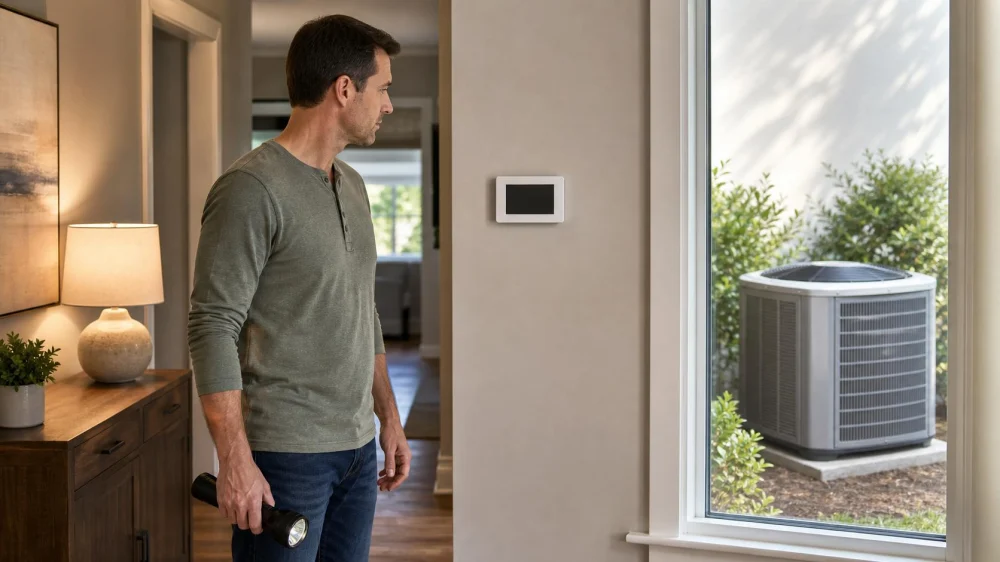
After power returns, do not force an immediate AC start. Confirm there is no flooding, damaged wiring, burning odor, or utility warning; set the thermostat to off; then follow the system manufacturer’s and utility’s restart guidance. Restore cooling once, observe the indoor and outdoor units from a safe distance, and call an HVAC professional if the breaker trips or operation is abnormal.
Air conditioners, heat pumps, thermostats, disconnects, panels, surge devices, and generators differ. This guide covers safe observation and communication, not electrical testing or internal repair. Use the exact equipment manuals and advice from the electric utility and qualified HVAC or electrical professionals.

What to do during the outage
Set the thermostat system mode to off if it can be operated without opening equipment or touching wet surfaces. This prevents an immediate cooling call as power fluctuates or returns. A battery thermostat may remain lit even though the indoor and outdoor equipment have no power.
FEMA advises unplugging appliances and electronics during a power outage to reduce surge damage. Central HVAC equipment is usually hardwired, so do not try to unplug it or open an electrical panel casually. Ask the utility or a qualified professional how the home’s fixed equipment should be managed.
Keep windows and exterior doors closed when outdoor air is hotter or more humid than indoor air, unless ventilation is needed for another safety reason. Close blinds on sun-facing windows, limit heat-producing cooking, and move people to a cooler level of the home.
Monitor utility alerts. Note the outage start, any repeated flickering or partial restoration, storm or flood conditions, and when steady power returns. These details can help a technician understand what happened.
If anyone depends on powered medical equipment or the home is dangerously hot, use the emergency plan and go to a safe cooled location. Do not wait for the AC to become a health solution.
Mister Sparky of Columbia
West ColumbiaLexington CountySouth Carolina
560 Chris Dr, West Columbia, SC 29169, USA
Check conditions before restarting
Wait until the utility indicates that service has been restored and the home appears to have stable power. Then check from safe, accessible locations:
- Is there standing water near the outdoor unit, indoor air handler, electrical panel, outlet, disconnect, or wiring?
- Are power lines, poles, tree limbs, or service equipment damaged?
- Do you smell burning, melting plastic, fuel, or another unusual odor?
- Do lights remain unusually dim or bright, or do only some circuits appear restored?
- Is the outdoor unit visibly damaged or obstructed by storm debris?
- Did the utility issue voltage, flood, fire, or equipment instructions?
- Does the thermostat show an error or remain blank after power is stable?
Do not approach a fallen line, flooded electrical equipment, sparking device, or damaged service connection. Keep people away and contact the utility or emergency services. Electrical equipment exposed to water needs professional evaluation before use.
Look without removing panels or guards. Do not reach into the outdoor unit, touch a capacitor, open a disconnect, or probe wiring. Storm debris touching the fan or coil should be removed only after the equipment is safely de-energized and the person is qualified to do so.
Use the equipment’s restart sequence
Find the model-specific owner’s manual and thermostat instructions. Some systems and thermostats include a compressor-protection delay after a power interruption. The display may indicate “wait,” “delay,” or a similar status. Let that feature work; do not cycle settings repeatedly.
A conservative homeowner sequence is:
- Leave the thermostat in off mode while confirming safe conditions and current instructions.
- Wait the amount of time specified by the manufacturer, thermostat, installer, or utility; there is no universal delay for every system.
- Confirm the filter and accessible supply and return vents were not disturbed during the outage.
- Set the thermostat to cooling and choose a normal target, not an extreme low setting.
- Allow the programmed delay and one normal start attempt.
- Observe operation without opening equipment.
For a window or portable unit, follow its manual for reconnection and reset buttons. Do not use an ordinary extension cord, damaged receptacle, or improvised power strip.
Observe the first cooling cycle
From inside, listen for the normal indoor fan and feel for airflow at a representative supply vent. Check the thermostat for a cooling call and error messages. Temperature change across the home takes time, especially after a long summer outage.
From a safe ground-level distance, see whether the outdoor unit starts after any normal delay. Listen for the usual sound pattern. Do not touch the cabinet, fan guard, refrigerant lines, or electrical components to “see if they are working.”
Record:
- the time cooling was requested;
- the time the indoor fan and outdoor unit started;
- thermostat messages or blank display;
- unusual humming, buzzing, clicking, rattling, or silence;
- whether airflow is normal at several vents;
- whether water appears in an unexpected location;
- the indoor temperature and humidity trend over one to two hours.
Do not expect an immediate return to setpoint. The building, furniture, and contents have stored heat. If airflow and operation appear normal, reduce indoor heat gains and allow recovery without changing settings every few minutes.
Know when to stop and call
Turn the thermostat off and contact a qualified HVAC professional if you notice:
- a breaker that trips again after power is restored;
- burning odor, smoke, sparks, scorching, or melted material;
- loud buzzing or humming without a normal start;
- rapid repeated starting and stopping;
- an outdoor fan that is not turning while the unit sounds energized;
- grinding, metal impact, or strong vibration;
- water near electrical equipment or unexpected indoor leaking;
- visible storm damage, a bent guard, or debris inside the unit;
- an error that returns after the manual’s allowed reset;
- no cooling after the system has had a reasonable recovery period.
Call emergency services for fire, smoke, sparking equipment, a suspected gas leak, a fallen line, or immediate danger. Do not wait for a routine HVAC appointment.
Handle breaker questions safely
A tripped breaker can signal overload, short circuit, damaged wiring, compressor or motor trouble, water exposure, or another fault. It is a protective device, not an on/off troubleshooting tool.
Do not repeatedly reset a breaker. If the equipment manual and your safety plan allow one reset, first set the thermostat off and make sure there is no water, odor, heat, or visible damage. If the breaker does not remain set or trips when cooling starts, leave it off and call a qualified professional.
Never remove the panel cover, bypass a breaker, install a larger breaker, hold a switch in position, or replace a fuse with a different rating. These actions can create shock and fire hazards and can damage equipment.
If you are unsure which breaker serves the AC, do not experiment. Use the electrical schedule only when it is accurate, or ask a licensed electrician or HVAC technician to identify the circuit.
Keep generators separate from DIY HVAC work
A portable generator should never be operated inside a home, garage, basement, crawlspace, shed, or near doors, windows, or vents. FEMA advises keeping generators outdoors and at least 20 feet from building openings. Carbon monoxide can be fatal even when doors are open.
Do not connect a generator to a household receptacle to backfeed the home. Powering central air conditioning requires a properly designed generator or standby system, correct capacity, approved transfer equipment, permits where required, and installation by qualified professionals.
Starting an AC compressor creates a substantial electrical load. A generator that runs lights and a refrigerator may not be able to start or support central cooling. Let the generator and HVAC professionals determine compatibility.
Protect comfort while AC is unavailable
Use battery-powered fans only when indoor temperature is below body temperature and the fan improves comfort. Close blinds, reduce oven and dryer use, drink water, and spend time on a lower shaded level. Check on older adults, infants, people with chronic conditions, and pets.
During extreme heat, follow local public-health guidance and move to a cooling center, library, community facility, or another air-conditioned location. A power outage can become a medical emergency before a repair appointment is available.
If outside air becomes cooler and less humid than indoors, safe window ventilation may help. Close windows again when outdoor heat, humidity, smoke, or pollution makes indoor conditions worse.
Prepare useful service notes
Give the technician a concise timeline:
- outage start and restoration times;
- whether power flickered or returned in stages;
- storm, flood, lightning, or utility events;
- thermostat mode and messages;
- what started, what did not, and after what delay;
- breaker position and whether any allowed reset was attempted;
- sounds, odors, water, and visible damage;
- system model numbers available without opening equipment.
Do not clear an error history or perform repeated resets before service. The original symptom can be more useful than a temporarily changed state.
Restart checklist
- Set the thermostat off during unstable power.
- Follow utility alerts and FEMA outage guidance.
- Check for water, damage, odors, and abnormal household power.
- Stay away from lines and wet electrical equipment.
- Read the equipment and thermostat restart instructions.
- Wait the specified delay; do not cycle settings.
- Request cooling once at a normal setpoint.
- Observe the indoor and outdoor units from a safe distance.
- Stop for abnormal operation or a repeated breaker trip.
- Use only professionally installed generator connections.
Frequently asked questions
How long should I wait before restarting the AC?
Use the delay specified by the manufacturer, thermostat, installer, or utility. Systems differ, and some have built-in compressor protection. There is no universal wait time.
Why does the thermostat say “wait”?
It may be enforcing a compressor-protection delay. Leave the settings alone and follow the thermostat manual. Call for service if the message does not clear as documented.
Can I reset the AC breaker several times?
No. Repeated trips indicate a fault or unsafe condition. Leave the equipment off and call a qualified professional.
Why is the indoor fan running but the outdoor unit is not?
Possible causes include a programmed delay, power issue, control problem, protection device, or equipment fault. Do not open the unit; record the status and contact a technician if normal operation does not resume.
Will setting the thermostat very low cool the house faster?
Not for a conventional fixed-capacity system. Use a normal target and allow time for the building to lose stored heat.
Can a portable generator run central AC?
Only when qualified professionals have designed an approved, correctly sized system with proper transfer equipment. Never improvise or backfeed a home receptacle.
Sources and evidence notes
- FEMA Ready.gov: Power Outage Hazard Information advises unplugging equipment for surge protection, using generators safely, and planning for cooling and medical needs.
- U.S. Consumer Product Safety Commission: Power Outage Safety explains generator carbon-monoxide and fire risks.
- FEMA Ready.gov: Power Outages provides current household outage preparation and response guidance.
The AC restart sequence is intentionally equipment-specific. Manufacturer instructions, utility notices, and qualified professional assessment control the exact steps.
Next steps
Save the AC, thermostat, and surge-device manuals before the next storm. Label the system model and service contact, record a safe outage plan, and identify a cooled alternative location. After an outage, restore cooling only after safe conditions and the required delay are confirmed, then make one observed start attempt.
 ATS Mechanical Heating & AC-Tomball5.0 (38 reviews)
 AirWise Solutions HVAC4.0 (3 reviews)
 Extreme Heating and Air Conditioning and Electrical Services4.0 (211 reviews)
 My Guys Plumbing Heating & Air4.0 (298 reviews)
 Ed's Heating Cooling Plumbing Electric4.0 (318 reviews)
 Northpoint Heating & Air Inc4.0 (152 reviews)
 Why Your Air Conditioner Might Be Tripping the Breaker and How to Fix It
 AC After a Power Outage: A Safe Restart Checklist
 Complete Guide: Air Conditioning Replacement for Homeowners in 2025
 How Much Does It Really Cost to Fix Air Conditioning Leak? | AC Repair Guide
 Top Ways to Fix Your AC Unit Quickly and Affordably in Your Area
 How to Replace an AC Unit: The Ultimate Checklist for Success