
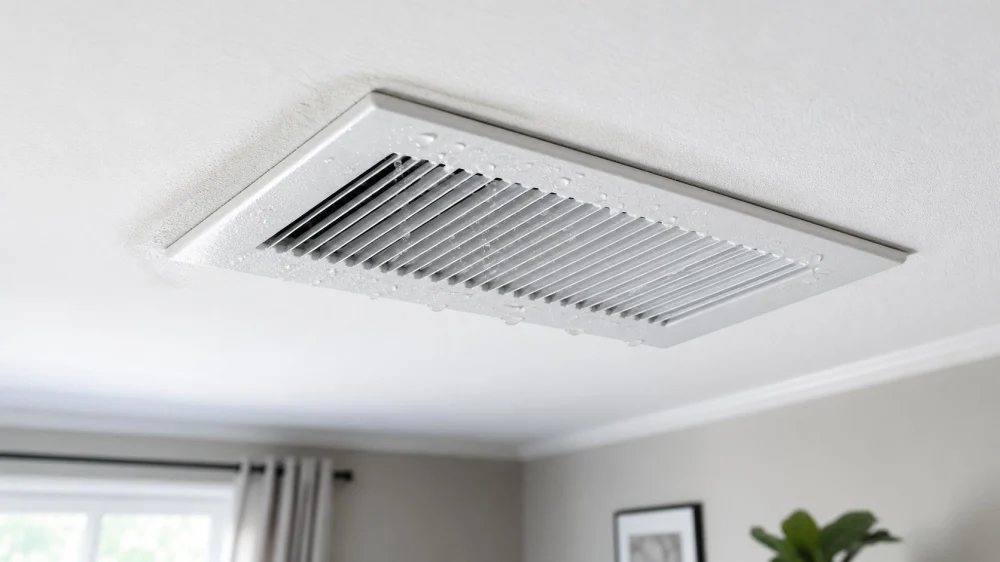
Why AC Vents Sweat and When Condensation Needs Attention
On this page
- Quick answer
- What “sweating” at an AC vent means
- Map where and when moisture appears
- Safe homeowner checks
- Possible humidity, airflow, and duct causes
- Protect finishes without hiding the cause
- What an HVAC professional should measure
- Urgent signs, limitations, and evidence notes
- Frequently asked questions
- Conclusion and next steps
Quick answer
An AC vent “sweats” when humid air contacts a register, boot, or nearby surface cold enough for water vapour to condense. Dry the visible water, protect the floor, keep registers open, close humid outdoor-air paths, and record humidity and timing. Repeated moisture needs HVAC inspection for airflow, duct leakage, insulation, air sealing, system operation, and indoor humidity—especially when ceilings stain or electrical parts get wet.

Advanced Environment Solutions, Inc
FredericksburgStafford CountyVirginia
5 Le Way Dr STE 109, Fredericksburg, VA 22406, USA
What “sweating” at an AC vent means
Condensation is liquid water formed when air cools below its dew point on a surface. At a supply vent, the grille and metal boot can become cold while surrounding indoor or attic air contains substantial moisture. Droplets then form on metal, paint, drywall, or nearby duct insulation.
This differs from water travelling through the duct from another source. A roof leak, plumbing leak, overflowing drain pan, disconnected condensate line, or wet building cavity can also appear near a vent. The location alone does not prove ordinary surface condensation.
A light film during an unusual humidity event and repeated dripping that stains a ceiling are not the same condition. Frequency, amount, affected vents, weather, and system runtime guide the next step.

Bryant Service Heating & Air
1839 Victor Rd NW, Lancaster, OH 43130, USA
Map where and when moisture appears
- Identify the component. Note whether water is on the grille face, around its perimeter, on adjacent drywall, inside the duct, or dripping from another surface.
- Count affected vents. One vent suggests a local boot, insulation, air-leakage, or room condition; many vents can point to broader humidity or system factors.
- Record timing. Does it occur at startup, after long runtime, overnight, during rain, after showering or cooking, or when doors and windows are open?
- Note the space around it. Is the duct above an attic, crawlspace, garage, basement, exterior wall, or conditioned floor?
- Measure room conditions. Use a reliable indoor thermometer-hygrometer away from the supply stream and direct sun. Record the location and time rather than relying on one reading.
- Photograph change. Capture droplets, paint or drywall staining, and the affected area before wiping it dry.
Do not insert a humidity meter, camera, hand, or cloth into a running duct. Surface observations are enough to prepare for service.
Safe homeowner checks
- Confirm the supply register is open and not covered by furniture, rugs, curtains, or magnetic covers.
- Check that accessible return grilles are unobstructed.
- Close exterior doors and windows while the AC runs when outdoor air is hot and humid.
- Use bathroom and kitchen exhaust fans according to their instructions and verify they discharge as designed rather than into an attic.
- Check the central filter only if it is safely accessible, using the correct size, type, and airflow direction specified for the system.
- Look for nearby water sources such as a plumbing line, roof stain, bathroom, laundry, or overflowing drain pan without opening equipment.
- Wipe the visible grille and surrounding finish dry with the system off if you can do so without removing components or touching electrical parts.
Do not close other vents to increase flow, set the thermostat extremely low, remove the register from a ceiling opening, cut duct insulation, open the air handler, or add unapproved insulation around a wet assembly.
Possible humidity, airflow, and duct causes
- High indoor humidity: Outdoor-air leakage, open windows, showers, cooking, wet basements, ventilation imbalance, or moisture sources can raise dew point.
- Cold register and boot: Normal cold supply air can chill metal below the surrounding air's dew point when humidity is high enough.
- Missing or damaged insulation: An uninsulated or poorly insulated boot and duct in a hot humid attic or crawlspace can create condensation on outer surfaces.
- Air leakage around the boot: Humid unconditioned air may be drawn through gaps around a ceiling or floor penetration and contact cold metal.
- Duct leakage: Supply or return leakage can alter pressure, airflow, temperature, and moisture movement.
- Restricted airflow: A blocked grille, unsuitable filter, dirty coil, blower issue, collapsed duct, or closed damper can make system conditions abnormal. Diagnosis requires measurement.
- System sizing or control: Short runtimes, incorrect setup, or control problems can reduce moisture removal even when temperature reaches the setpoint.
- Non-HVAC water source: Roof, plumbing, drain-pan, or condensate-line water can mimic a sweating vent.
Do not assume that colder air is automatically better. Excessive temperature difference, low airflow, or unusual coil conditions can signal a problem, but vent temperature alone does not diagnose refrigerant.
Protect finishes without hiding the cause
Place a dry towel or container below a drip only if it does not create a trip hazard, block the register, or contact electricity. Remove wet belongings and dry the visible surface. Mark the edge of a stain lightly with date and time when appropriate.
Do not paint over an active stain, seal a wet grille to the ceiling, or wrap the exterior with household foam. Trapping water can conceal damaged drywall, corrosion, microbial growth, or a continuing leak.
If drywall softens, sags, crumbles, or develops a growing bulge, keep people away. Wet ceiling material can fall. A large water source may need building, plumbing, roofing, or emergency help in addition to HVAC service.
Visible mould-like growth or persistent musty odour requires moisture correction and appropriate assessment. Do not disturb a large or uncertain affected area, and do not spray chemicals into the duct.
What an HVAC professional should measure
- Confirm whether the water is surface condensation or travelling from another source.
- Measure indoor temperature and relative humidity under representative conditions.
- Measure supply and return air temperatures and system airflow using appropriate instruments.
- Check static pressure, filter, blower setup, coil condition, and controls.
- Inspect accessible duct and boot insulation, vapour control, seals, joints, and support.
- Evaluate leakage and pressure between conditioned rooms and attic, crawlspace, garage, or outdoors.
- Inspect condensate pan, trap, drain, and related components without confusing them with surface moisture.
- Review ventilation and humidity sources and recommend coordinated building-envelope work if necessary.
Ask how the proposed fix addresses the measured cause. Replacing a grille may stop rust marks but will not correct attic air leakage or high indoor humidity by itself.
Urgent signs, limitations, and evidence notes
Turn the system off and seek prompt help for water in electrical equipment, sparking, burning odour, repeated breaker trips, a rapidly spreading ceiling stain, overflowing equipment pan, severe sagging, or water near a light fixture. Follow emergency guidance for smoke, fire, gas odour, or a carbon monoxide alarm.
This article reflects common residential cooling and moisture practice in the United States. Surface droplets cannot establish airflow, insulation condition, dew point at hidden surfaces, duct leakage, refrigerant condition, or the source of water. Measurements and physical inspection are stronger evidence.
Mechanical, electrical, energy, moisture, and building requirements vary by state, municipality, equipment, and project scope. Refrigerant and electrical work require qualified people, and hidden mould or building-material hazards may require specialized assessment.
Frequently asked questions
Is a little condensation on an AC vent normal?
It can occur during unusual humidity, but repeated droplets, staining, rust, or dripping indicate conditions worth investigating. Document when it happens and ask an HVAC professional to identify the moisture path.
Will lowering the thermostat stop vent sweating?
It may make the register colder and can worsen condensation. Use a normal comfort setting and diagnose humidity, airflow, insulation, leakage, and system operation instead.
Can a dirty filter cause sweating vents?
A restrictive or unsuitable filter can reduce airflow and contribute to abnormal system conditions, but it is not the only cause. Replace it only with the specified type and have persistent moisture measured.
Why does only one ceiling vent sweat?
A local boot may lack insulation or sealing, the branch may have different airflow, or humid attic air may reach that opening. A roof or plumbing source near the same vent is also possible.
Should I insulate around the vent myself?
Not before identifying the water source and approved assembly. Incorrect insulation or vapour control can trap moisture, violate clearances, or hide damage. Have the boot, duct, ceiling opening, and surrounding space assessed.
Conclusion and next steps
Dry the visible area, keep airflow paths open, close humid outdoor-air sources, and document room humidity, weather, timing, and affected vents. Do not lower the thermostat aggressively or seal a wet assembly. Repeated condensation needs measured HVAC and building-envelope diagnosis so the fix addresses humidity, airflow, insulation, leakage, or another water source rather than only the grille.
 B-Cool Air Conditioning & Heating, Inc.4.0 (763 reviews)
 HE Powersports - Broken Bow, OK5.0 (104 reviews)
 Engle Services Heating & Air - Electrical - Plumbing4.0 (30 reviews)
 CE (Carrier Enterprise)5.0 (9 reviews)
 HS Services HVAC Inc.5.0 (9 reviews)
 SERVPRO of Albany and Americus4.0 (366 reviews)
 Fastest Way to Fix Air Conditioning Without Getting Overcharged – Quick Tips and Expert Advice
 How to Troubleshoot and Repair an Air Conditioner with Weak Airflow
 What to Do When You Need to Fix Your Air Conditioning Immediately: Fast Solutions
 How to Troubleshoot Air Conditioner Electrical Problems: Step-by-Step Guide
 How to Repair an Air Conditioner That’s Blowing Weak Air | Ac Fix
 Best Services That Can Fix My Air Conditioner Near You Today