
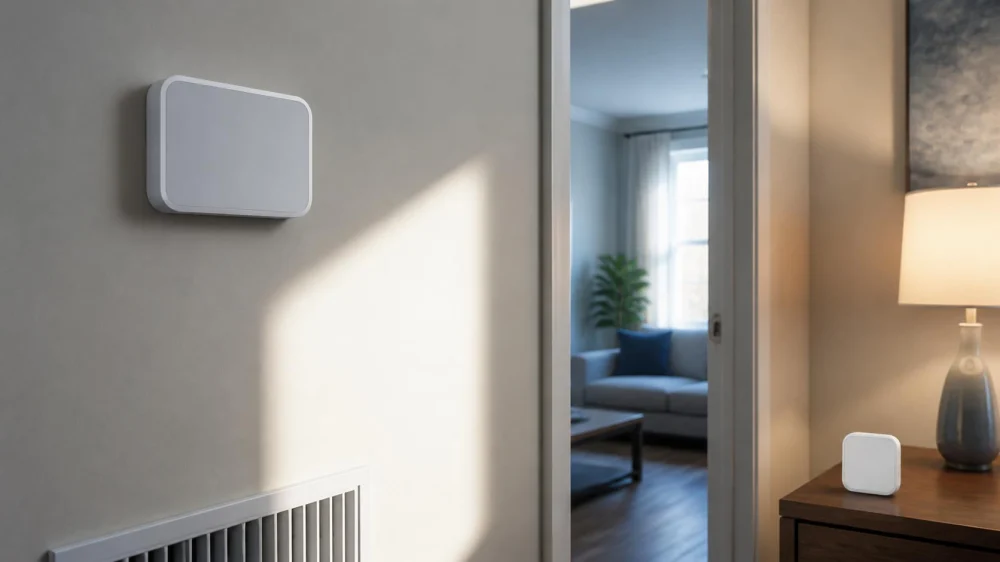
Thermostat Location: Check What May Distort the Reading
On this page
Quick answer
A thermostat can read differently from the occupied space when it is affected by direct sun, a supply register, return-air draft, exterior wall, kitchen heat, fireplace, electronics, open doorway, or an unusually warm or cool room. Record conditions before changing settings or moving the device.
Do not relocate thermostat wiring, open control equipment, or change installer calibration without the manufacturer’s instructions and qualified help. Comfort problems can also come from airflow, duct leakage, equipment sizing, humidity, insulation, zoning, or sensor faults.

What influences a thermostat
- afternoon sun through a window;
- air directly from a supply register;
- drafts at exterior doors or unsealed wall openings;
- heat from lamps, televisions, kitchens, or fireplaces;
- an exterior or uninsulated wall;
- a hallway that differs from occupied rooms;
- blocked circulation around the sensor; or
- remote sensors assigned to schedules.
A good location should represent the area the system is intended to control, subject to the system design.

Observe before relocating
For several days, record thermostat reading, setpoint, system status, outdoor conditions, time, sun exposure, occupancy, cooking, doors, and comfort in key rooms. Note whether the difference follows a predictable schedule.
Do not cover the thermostat to “protect” it from drafts; that can trap heat and delay sensing. Keep furniture and decorations away.
Compare temperatures carefully
Use a reliable room thermometer placed near the thermostat but not touching the wall. Let it stabilise. Then compare in occupied rooms at similar height, away from windows, vents, exterior walls, and electronics.
Small differences between devices can be normal. A large or changing gap deserves inspection, but consumer thermometer readings alone do not prove the thermostat is defective.
Check airflow and room use
Confirm registers are open and returns are not blocked. Check the filter according to the equipment manual. Closed doors can isolate rooms when there is no return path. Avoid closing multiple vents to force air elsewhere without HVAC guidance.
Rooms over garages, under attics, with large windows, or on different floors may need load, insulation, duct, or zoning evaluation rather than a thermostat move.
When relocation may help
An HVAC professional can evaluate an obviously biased location, wire route, control compatibility, wall cavity drafts, and system behaviour. Relocation should include safe wiring, wall repair, setup, calibration checks, and testing through a full cycle.
Do not place a thermostat merely where it is convenient to reach. Accessibility, representative temperature, airflow, and manufacturer clearance all matter.
Remote sensors and zoning
Some systems support remote room sensors, averaged readings, occupancy selection, or schedules. Confirm which sensor is active at each time. A sensor in an unused bedroom can control the whole system unexpectedly.
Zoned systems require correctly operating dampers, controls, and bypass design. Adding a sensor is not the same as adding true zoning.
Location checklist
- Map sun, vents, doors, heat sources, and room use.
- Record readings and comfort by time.
- Compare with a stabilised thermometer.
- Keep vents, returns, and sensor airflow clear.
- Confirm active remote sensor and schedule.
- Do not change calibration casually.
- Ask an HVAC professional before relocation.
Frequently asked questions
Should a thermostat be on an interior wall?
Often, but the exact representative location and manufacturer guidance matter.
Can sunlight make it read high?
Yes. Record the pattern and shield the room with normal window treatments, not by covering the thermostat.
Can a nearby vent affect it?
Yes. Direct supply air can distort the reading.
Should I adjust calibration?
Only after verifying instruments and following manufacturer or technician guidance.
Would a remote sensor fix upstairs comfort?
It may change control priority, but duct, load, or zoning problems may remain.
Can I move it myself?
Wiring and system setup can be damaged; use qualified help unless the manual clearly supports user relocation.
Sources and evidence notes
The thermostat and HVAC equipment manuals define approved locations, wiring, sensor behaviour, calibration, and setup. Models and system types vary.
A comfort diagnosis may require temperature, humidity, airflow, static pressure, load, duct, insulation, and control checks. A thermostat location is one possible factor, not a complete diagnosis.
Conclusion and next steps
Map nearby sun, drafts, vents, heat sources, and occupied rooms before blaming the thermostat. Compare readings consistently, keep airflow clear, and verify remote-sensor schedules. Ask an HVAC professional to evaluate system performance and relocation rather than moving wiring or changing calibration by guesswork.
 Chickasaw Air Conditioning, Inc.4.0 (25 reviews)
 Wright's Air Conditioning and Heating, Inc4.0 (150 reviews)
 Swift Brothers Plumbing, Heating & Air4.0 (252 reviews)
 Dyess Air & Plumbing4.0 (1800 reviews)
 Renfrow Heating Cooling Plumbing & Electrical4.0 (124 reviews)
 Mechanical Specialty Systems0.0 (0 reviews)
 How to Handle an Air Conditioner Compressor Problem and Avoid Costly Repairs
 How to Review an AC Repair Invoice Before You File It
 How to Avoid the Most Common Air Conditioning Repair Mistakes for Homeowners
 The Ultimate Checklist to Fix Air Conditioning Leak Successfully in 2025
 Frozen AC Coil: Stop Cooling and Let the Ice Melt Safely
 Complete Guide: Cheap AC Fix for Homeowners in 2025