
Low AC Refrigerant: Ask for Leak Diagnosis Before a Top-Off
Table of contents
Quick answer
A home air conditioner does not normally consume refrigerant like fuel. If the charge is low, ask an EPA Section 608-certified technician to diagnose why, identify and repair leaks when feasible, and charge the exact approved refrigerant to manufacturer specifications. A top-off may briefly improve cooling but does not permanently repair a leaking system.
Refrigerant is not fuel
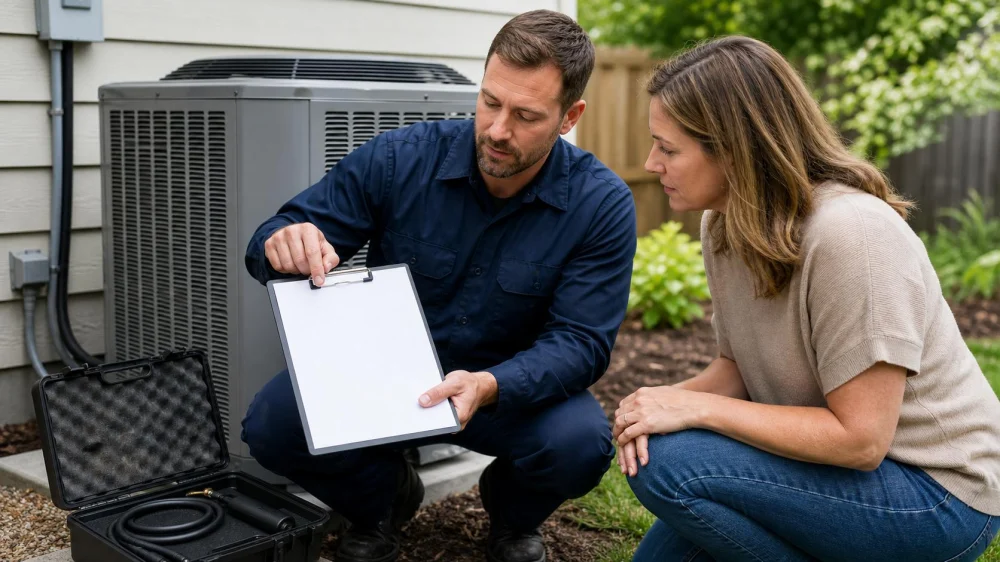
Refrigerant circulates in a sealed system. Low charge can result from a leak, an earlier service error, or a system that was never charged correctly. Symptoms such as weak cooling, long runtimes, ice, or high bills are not proof; airflow, controls, coils, ducts, and equipment sizing can produce similar signs.
EPA advises homeowners with leaking air conditioners to ask technicians to locate and repair the leak rather than simply topping off the system. Refrigerant emissions affect the environment, and intentionally venting regulated refrigerants during service is prohibited.
Questions for the technician
- What measurements show that the charge is incorrect?
- What refrigerant does the equipment nameplate specify?
- How will the system be checked for leaks, and what limits does the method have?
- Where is the confirmed or suspected leak?
- Can it be repaired, and how will the repair be verified?
- Will remaining refrigerant be recovered with certified equipment?
- How much refrigerant will be added by weight, and how will final performance be checked?
- Is the technician Section 608-certified for this work?
Compare repair options
Ask for written options that separate diagnosis, leak detection, repair, refrigerant, labour, warranty, and follow-up. A small accessible leak may justify repair; an obsolete or extensively leaking coil may change the economics. Equipment age, refrigerant availability, energy use, matched components, warranty, and expected remaining life belong in the comparison.
Do not approve an unlisted substitute or “drop-in” refrigerant. EPA notes that alternatives may require system changes and that equipment typically operates best with the refrigerant type for which it was designed.
Records to keep
- model and serial numbers and nameplate photo;
- refrigerant type and amount recovered or added;
- leak-test method, location, and result;
- parts replaced and repair verification;
- before-and-after operating measurements;
- technician company, certification, invoice, and warranty;
- dates of any previous recharge or recurring symptom.
Limitations
A homeowner cannot safely confirm charge or find every leak by observation. Correct diagnosis depends on system type, ambient and indoor conditions, airflow, manufacturer data, and professional instruments. Federal leak-repair thresholds for large appliances do not necessarily impose the same rule on a small residential system, but EPA still recommends repair rather than repeated top-offs.
FAQ
Does refrigerant need annual topping off?
No. Routine seasonal maintenance may include checking performance, but regular addition suggests a leak or prior charge problem.
Can I buy a recharge kit?
Do not open or charge a residential system yourself. Refrigerant work requires certification, recovery equipment, correct identification, and precise procedures.
What if the leak is very small?
Ask about detection confidence, repair feasibility, environmental impact, cost, and a follow-up plan rather than assuming repeated recharge is harmless.
Must an old R-22 system be replaced immediately?
EPA does not require automatic conversion solely because it uses HCFC-22. Compare lawful repair, retrofit, and replacement with a qualified contractor.
Sources and evidence notes
- EPA: Homeowners and Consumers FAQ — leak repair, refrigerant identification, certified technicians, and retrofit context.
- EPA: Purchasing and Repairing Home Air Conditioners or Heat Pumps — repair, refrigerant transitions, and certification.
Next steps
Photograph the nameplate, gather prior invoices, and request a written diagnosis from a Section 608-certified technician. Approve refrigerant only as part of a measured, documented plan that addresses the cause and verifies system performance.
 ABC Air Conditioning & Heating Specialists4.0 (85 reviews)
 CE (Carrier Enterprise)3.0 (3 reviews)
 Hemco4.0 (15 reviews)
 Indoor Comfort Team4.0 (568 reviews)
 Affordable Heating & Air Conditioning4.0 (24 reviews)
 Air Waves5.0 (3 reviews)
 How to Check for Air Leaks in Your Air Conditioner and Fix Them
 What to Do When You Need to Fix Your Air Conditioner Immediately
 How to Solve Air Conditioner Noisy Fan Problems
 Everything You Need to Know Before You Fix Your Air Conditioner
 How to Test Your Air Conditioner’s Efficiency and Fix Issues for Optimal Cooling
 Best Services That Cheap AC Fix Near You Today | Ac Fix