
AC Refrigerant Line Insulation: What Homeowners Can Check
Table of contents
Quick answer
The larger copper refrigerant line on many split air conditioners is covered with dark foam insulation. Homeowners can look for missing sections, open seams, brittle foam, sun damage, or persistent moisture without touching electrical parts or opening equipment. Photograph damage and arrange HVAC service; refrigerant diagnosis, line repair, and charging belong to trained professionals.
Franks Air Conditioning & Heating
ZephyrhillsPasco CountyFlorida
37812 FL-54, Zephyrhills, FL 33542, USA
Why refrigerant line insulation matters
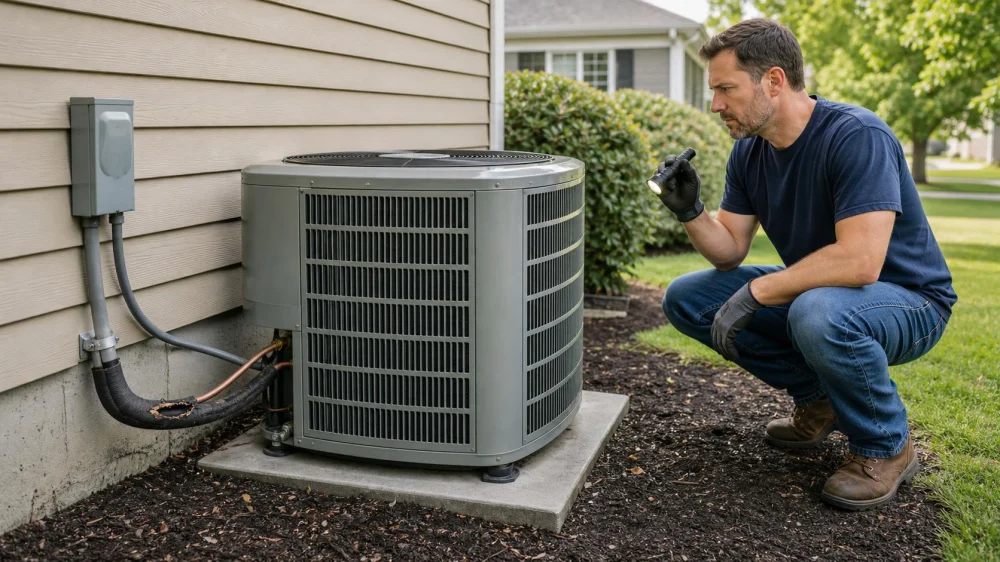
A central split air conditioner moves refrigerant between the indoor and outdoor equipment through copper tubing. The larger, cooler line is commonly called the suction line. Its insulation limits unwanted heat gain and helps control surface condensation while the system operates. The smaller line may be bare on many systems, but the correct arrangement depends on the equipment manufacturer's instructions.
Insulation outdoors also faces sunlight, rain, pests, landscaping tools, and normal aging. The U.S. Department of Energy's home-performance guidance calls for suction-line insulation and protection against ultraviolet degradation according to manufacturer specifications or applicable requirements. That does not mean every visible imperfection is an emergency, but gaps and crumbling material deserve documentation and timely review.

A safe visual inspection
- Choose a dry, well-lit time. Stay on stable ground and keep children and pets away from the outdoor unit.
- Turn cooling off at the thermostat. Do not remove panels or reach through the condenser grille. Turning the thermostat off is not a substitute for electrical isolation, so treat the equipment as energized.
- Follow the line set with your eyes. Look from the outdoor unit toward the wall entry and, where readily visible, near the indoor air handler.
- Check the foam jacket. Note missing pieces, long splits, separated joints, compressed sections, powdery surfaces, or exposed copper on the larger line.
- Check the wall entry. Record gaps, loose sleeves, damaged exterior sealant, or signs that water could enter. Do not pack material around wiring or lines.
- Take wide and close photos. Include the equipment model label only if it is reachable without leaning over or touching components.
- Restart only if conditions appear normal. If you see damaged wiring, oil-like residue, heavy ice, smoke, or hear hissing, leave the system off and call for service.
Damage signs to record
- Foam that is cracked, brittle, chalky, or missing after sun exposure
- An open longitudinal seam or loose joint between insulation sections
- Exposed copper on the larger refrigerant line
- Repeated condensation dripping from an uninsulated indoor section
- Ice on the copper, insulation, indoor coil cabinet, or nearby fittings
- Dark, oily residue near a fitting, accompanied by reduced cooling
- Rub marks where tubing touches metal, masonry, or another pipe
- Animal chewing, mower damage, or a crushed line-set cover
Condensation alone does not prove a refrigerant leak, and damaged insulation does not prove the refrigerant charge is wrong. Ice can be associated with airflow problems, coil conditions, controls, or refrigerant-system faults. A systematic diagnosis is more reliable than guessing from one symptom.
What not to do
- Do not cut, bend, squeeze, sand, or disconnect copper tubing.
- Do not apply an open flame, heat gun, spray foam, or unknown adhesive.
- Do not cover service valves, access caps, wiring, identification labels, or drainage openings.
- Do not add refrigerant or use a retail recharge kit. Refrigerant work requires appropriate tools, training, and compliance with environmental rules.
- Do not keep resetting a breaker or run equipment that has ice, damaged wiring, burning odor, smoke, or unusual loud operation.
What an HVAC technician may check
Share the photos, when you first noticed the damage, whether cooling changed, and whether ice or water appears only while the system runs. A technician can compare the line configuration with the equipment instructions, inspect the entire accessible line set, select compatible closed-cell insulation, seal joints appropriately, and protect outdoor material from ultraviolet exposure.
If performance symptoms are present, the visit may also include airflow, coil condition, temperature, control operation, and refrigerant-system checks. ENERGY STAR's maintenance checklist includes checking refrigerant level and system operation, while Department of Energy consumer guidance advises using a trained professional when an air conditioner needs more than basic maintenance.
Limitations and safety notes
This guide is for a ground-level visual check, not diagnosis or repair. Line sizes, refrigerants, insulation requirements, and approved materials vary by model, climate, building code, and installation. Follow the equipment manual and local requirements. Do not enter attics, crawl spaces, roofs, or other hazardous areas simply to inspect a line.
Leave immediately and contact emergency services if there is fire, smoke, arcing, or another immediate danger. If refrigerant exposure is suspected, move to fresh air and seek guidance from local emergency or poison-control resources. Keep the system off until a qualified professional says it is safe to operate.
Frequently asked questions
Should both copper refrigerant lines be insulated?
Often the larger suction line is insulated while the smaller liquid line is not, but system designs vary. The manufacturer's installation instructions are the controlling reference for a particular model.
Can damaged insulation make the AC stop cooling?
Missing insulation can add unwanted heat gain and allow condensation, but a major cooling problem may have other causes. Filter condition, airflow, dirty coils, controls, and refrigerant-system faults should be evaluated in a logical order.
Is water on the outside line always a problem?
A cool suction line can produce condensation in humid weather. Persistent dripping at an indoor gap, soaked building materials, or condensation caused by missing insulation deserves prompt review. Ice is a different warning sign and should not be ignored.
Can I wrap the line with household tape?
Household tape is not a durable substitute for correctly sized, compatible insulation and weather protection. It can hide damage, trap water, or block service access. Ask a technician for a repair matched to the equipment and exposure.
Sources and evidence
- U.S. Department of Energy: Standard Work Specifications for Single-Family Home Energy Upgrades — refrigerant-line insulation and ultraviolet-protection guidance.
- ENERGY STAR: Heating and Cooling Maintenance Checklist — professional cooling-system and refrigerant checks.
- U.S. Department of Energy: Home Cooling 101 — basic maintenance boundaries and trained-technician guidance.
Conclusion and next steps
Give the accessible refrigerant-line insulation a visual check at the start of cooling season and after landscaping or exterior work. Save photos of any gap, brittle foam, moisture pattern, or exposed copper, then schedule qualified service before a small weathering problem grows. Stop operation and get prompt help when damage appears with ice, oil-like residue, electrical trouble, hissing, smoke, or poor cooling.

 inAir Heating & Air Conditioning4.0 (315 reviews)
 Norfolk Air Heating, Cooling, Plumbing & Electrical4.0 (1915 reviews)
 Wade's Repair Service Inc4.0 (55 reviews)
 Alpha Air LLC2.0 (3 reviews)
 Sears Heating and Air Conditioning5.0 (1 reviews)
 K&E A/C and Refrigeration, Inc.5.0 (263 reviews)
 What to Do When You Need to Fix Air Conditioning Immediately
 The Complete Guide to AC Fan and Motor Repair
 Everything You Need to Know Before You Fix Your Air Conditioner
 How to Identify and Fix an Air Conditioner Blower Fan Failure
 How to Fix a Water Leak from Your AC Condensation Line: Step-by-Step Homeowner Guide
 Best Services That Fix Air Conditioning Near You Today