
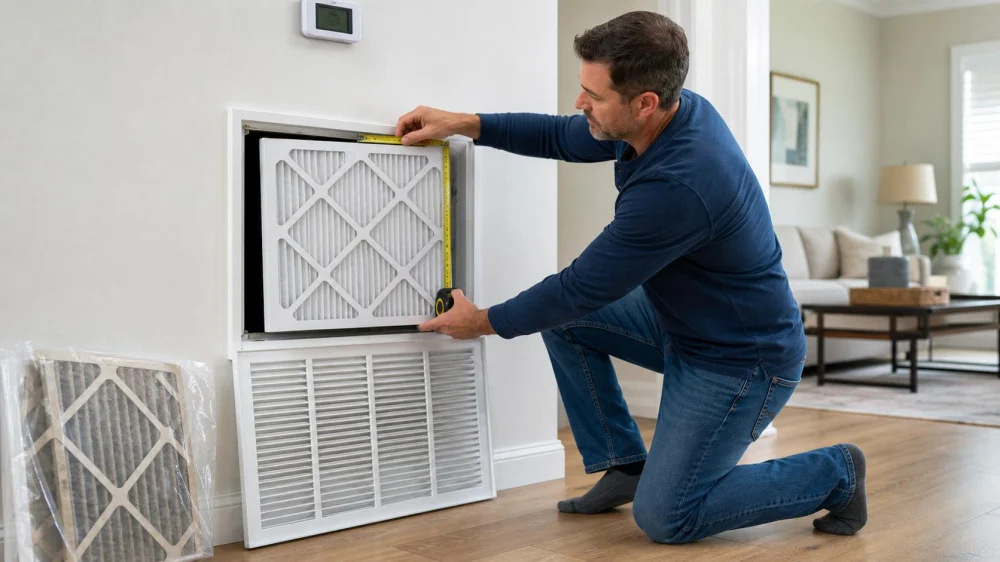
AC Filter Size: Check the Label Before You Buy
Table of contents
Quick answer
Copy the size and model information from the correctly fitted old filter, then confirm it against the air-handler label or equipment manual before buying. Filter packages often show a nominal size while the frame has slightly smaller actual dimensions. If information is missing, switch the system off and measure the filter—not exposed equipment. Never force a filter, stack two filters, or assume a higher filtration rating suits the system.

Find every filter location
Homes can have one filter at the furnace or air handler, one at a large return grille, or multiple filters at separate return grilles. Replacing the wrong location while leaving another filter dirty can restrict airflow.
- Check the equipment manual and service records.
- Look for a filter cabinet beside the indoor unit.
- Inspect large return grilles that open with a latch.
- Ask the previous owner, property manager, or HVAC company about less obvious locations.
- Do not open sealed panels or remove screws to search for a filter.
If the access is in an attic, crawlspace, tall ceiling, or near exposed electrical parts, ask a technician to identify and service it. A filter change should not require unsafe climbing or equipment disassembly.

Star Service, Inc.
Baton RougeEast Baton Rouge ParishLouisiana
527 N Acadian Thruway, Baton Rouge, LA 70806, USA
Read the old filter and equipment information
Set the thermostat so the blower will not start, then wait for the system to stop. Photograph the installed filter before removal, including its orientation and any arrows. Pull it out gently without shaking collected dust into the return.
Copy all useful details from the frame: listed size, product type, model, filtration rating, and airflow arrow. Check the filter cabinet or equipment documentation for a required size and allowable type. A handwritten note from a previous occupant is a clue, not proof that the installed filter was correct.
Place the used filter directly into a bag. Do not vacuum or wash a disposable filter unless the manufacturer specifically identifies it as reusable and provides a cleaning procedure.
Understand nominal and actual size
The large size printed on many filter packages is a nominal category used for shopping. The physical frame can be somewhat smaller. Two filters with similar package wording may have different actual dimensions, especially across brands or specialty media.
Compare all three dimensions: length, width, and thickness. Thickness matters because a filter that is too deep can keep the cover from closing, while a thinner filter may not seat in the designed tracks. Use the equipment's required format rather than rounding measurements to the nearest common size on your own.
Measure only when information is missing
If the old filter label is unreadable, measure the old frame first. Use a rigid ruler or tape and record the outer length, width, and thickness. Photograph the measurements and the slot.
Measure the accessible filter track only when the system is off, the area is dry, and no panel removal or contact with wiring is required. Do not insert a metal tape deeply into equipment. A technician should measure an empty or irregular cabinet when safe access is uncertain.
- Record dimensions in a consistent order.
- Note whether the filter slides into tracks, a cabinet, or a return grille.
- Check clearance for the door or grille to close fully.
- Compare the result with the equipment manual or dealer parts information.
Check fit and filtration compatibility
A correct filter should slide into the designed tracks without bending, large gaps, or improvised tape. It should not rattle loosely or require pressure to close the cover. A crushed filter frame can bypass air or interfere with the blower.
Size is only one part of compatibility. Filters also vary in media, pressure resistance, and efficiency rating. Selecting the highest number on the shelf is not automatically better for an existing system. Use the range allowed by the HVAC manufacturer or ask a qualified technician, especially if airflow has been weak, rooms are uneven, or the system has frozen or short-cycled.
Do not stack filters to create a missing thickness or add a second filter where the system was not designed for one.
Install, verify, and record the result
Find the airflow arrow on the new filter. It normally points toward the blower or air handler, but follow the equipment layout and instructions rather than guessing from room direction. Slide the filter squarely into the tracks and close the grille or cabinet completely.
Restart the system and listen from outside the closed equipment area. Stop and call a technician if the filter pulls out of position, the cover will not stay shut, the blower sounds abnormal, airflow drops sharply, or the system does not operate normally.
Save the exact replacement information in a phone note or home maintenance file. Include location, nominal size, actual dimensions, approved rating, installation date, and a photo of the package.
Buying checklist
- Identify every filter location without opening sealed equipment.
- Photograph the old filter orientation before removal.
- Copy size, model, rating, and product type.
- Confirm information in the equipment manual or cabinet label.
- Compare nominal and actual length, width, and thickness.
- Use only a filtration rating compatible with the system.
- Confirm the filter fits without force, gaps, or stacking.
- Record the final product and change date.
Limitations
This guide covers ordinary disposable filters in accessible residential return grilles or cabinets. Electronic air cleaners, washable media, deep media cabinets, custom sizes, zoning systems, and filters inside difficult equipment locations require their own instructions. A filter size check cannot diagnose airflow, duct, refrigerant, blower, or indoor air quality problems.
Frequently asked questions
Why is the filter smaller than the number on the package?
The package may use a nominal shopping size while the frame has smaller actual dimensions. Compare the physical measurements and equipment requirements, not only the large package number.
Can I use a thicker AC filter?
Only if the cabinet and equipment are designed for that thickness. A thicker filter is not interchangeable merely because its length and width match.
Should a filter fit tightly?
It should seat securely in the intended tracks without major gaps, but it should not require bending or force. The cover or grille must close normally.
Can I trim a filter to fit?
Do not cut a disposable framed filter. Trimming can damage the media and frame. Find the specified size or ask an HVAC technician about an approved custom solution.
What if there is no filter in the slot?
Do not guess from the opening or operate indefinitely without guidance. Check the equipment documentation and contact a technician to confirm the required type, size, and location.
Next steps
Take a clear photo of the old filter frame and equipment model information before shopping. Confirm the exact product with the manual, dealer, or HVAC technician, then buy one replacement and test the fit before purchasing a large case. Save the verified details for the next change.




 One HVAC American AC & Refrigeration5.0 (11 reviews)
 Doug’s Auto Repair4.0 (13 reviews)
 Master Cooling Connections AC & Heating LLC4.0 (34 reviews)
 BUDGET HEAT AND AIR4.0 (28 reviews)
 Infinity HVAC LLC4.0 (40 reviews)
 Coolray Mechanical4.0 (492 reviews)
 How to Prevent Air Conditioner Refrigerant Leaks
 How to Maintain Your Air Conditioner to Prevent Costly Repairs
 Best Services That Cheap AC Fix Near You Today
 How to Clean Air Conditioner Coils and Improve Cooling Efficiency
 How to Fix Water Leaks in Your Air Conditioner Fast
 Can You Fix My AC Without Replacing the Entire System? Expert Solutions Explained