
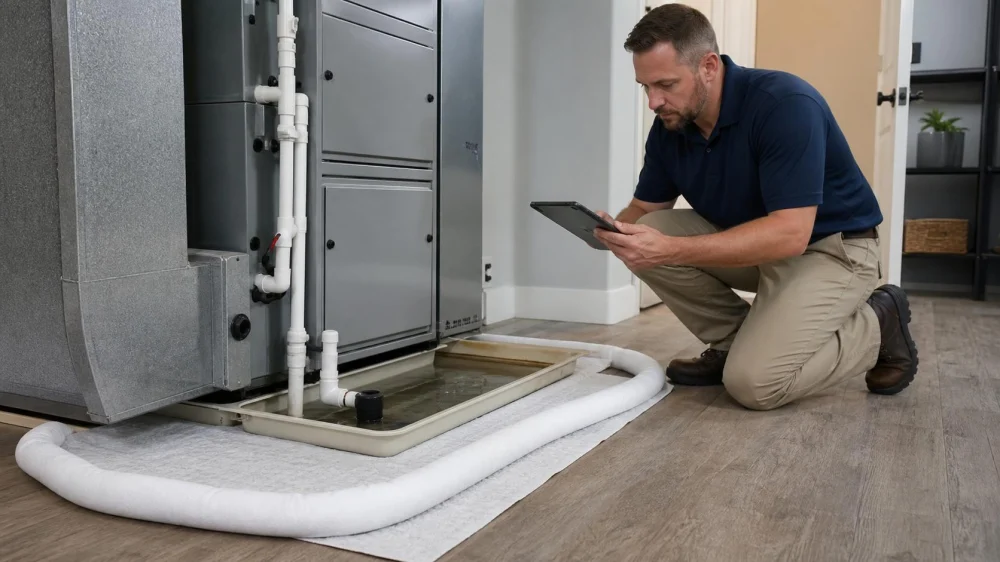
AC Drain Line Backup: Stop Water Before You Troubleshoot
On this page
Quick answer
If an air conditioner is leaking or its drain pan is filling, turn off cooling at the thermostat, keep water away from electrical equipment, protect nearby finishes, and photograph the location. Check only visible, accessible items such as a tipped float switch or a clearly blocked exterior outlet. Do not open energized panels, add harsh chemicals, or keep running the system. Arrange qualified HVAC service and water mitigation when needed.
Why it matters
Air-conditioning systems remove indoor moisture and route condensate through a drain. A blockage, damaged pan, failed pump, poor slope, frozen coil, or installation defect can send water into ceilings, floors, or equipment.
This United States guide is general safety information. Equipment design, local codes, drain termination, shared plumbing, electrical protection, climate, and warranties vary. Manufacturer instructions and qualified diagnosis control.

Practical checklist
- Turn off cooling and keep people away from wet electrical areas.
- Photograph the equipment, pan, water path, thermostat, and visible switch position.
- Move dry belongings and catch drips only where containers are stable and electrically safe.
- Note whether the indoor blower, condensate pump, or alarm is operating.
- Locate the accessible drain outlet without dismantling equipment.
- Record recent filter changes, icing, humidity, noises, and maintenance.
- Call an HVAC professional if water continues, the system will not stop, or access is unsafe.
Step-by-step plan
- Stop active cooling at the thermostat; use the service disconnect or breaker only when labels are clear and the area is dry.
- Protect the building without touching wet wiring, sagging ceilings, or contaminated water.
- Check the filter and visible return path if safely accessible, because restricted airflow can contribute to coil icing.
- Observe the pan, float switch, pump reservoir, and outlet from outside covers; do not bypass safety switches.
- Avoid bleach, acids, pressure, wire, or compressed gas unless the equipment manufacturer and technician specify the method.
- Give the technician a timeline, photos, water volume, alarm status, and prior repair history.
- After repair, confirm drainage, pan condition, insulation, pump operation, shutoff testing, and affected-building drying.
Keep model and serial numbers, photos, thermostat settings, weather and humidity, filter information, service findings, cleared material, parts, invoices, and moisture-restoration records.
Limits and warning signs
Water near an air handler does not prove a simple clogged line. Sources include frozen coils, cracked pans, failed pumps, loose fittings, roof or plumbing leaks, and condensation on uninsulated surfaces. A cleared line can clog again if the cause remains.
Call emergency or utility help for shock, sparking, fire, smoke, structural ceiling failure, or water reaching major electrical equipment. Use water-mitigation professionals for saturated materials or suspected contaminated water.
Frequently asked questions
Can I keep the fan running?
Do not assume it is safe. Follow manufacturer or technician instructions, especially with water, ice, or electrical concerns.
Should I pour bleach into the drain?
Not without approved instructions. Chemicals can damage components, react with residues, or expose occupants.
Can I bypass the float switch?
No. It is intended to stop overflow; bypassing it can cause water and equipment damage.
Why did the line clog again?
Biofilm, poor slope, debris, pump issues, trap or vent design, and recurring coil problems may need correction.
Sources and evidence
The article reflects common HVAC and electrical safety practice: stop cooling, isolate people from water and electricity, preserve evidence, avoid bypassing controls or using unapproved chemicals, and diagnose the complete condensate system.
Conclusion and next steps
Turn off cooling, protect the dry area, photograph the leak path, and call qualified HVAC service. Ask the technician to identify the source, test the overflow controls, and document drainage and building-drying needs before restarting.
 Maxx AC & Heating4.0 (304 reviews)
 Patriot Electric Services4.0 (1039 reviews)
 New AC Shop5.0 (2 reviews)
 Houston AC Repair Specialists5.0 (10 reviews)
 AireWave Heating and Cooling5.0 (129 reviews)
 Arc Electric Air Conditioning and Heating, Inc.4.0 (89 reviews)
 The Ultimate Checklist for Successfully Getting Your AC Fixed
 What You Need to Know About Air Conditioner Filter Replacement
 Pros and Cons of Trying to Fix a Wall Air Conditioner on Your Own
 Who Should You Trust When You Need to Fix Wall Air Conditioner
 Air Conditioner Troubleshooting: How to Fix an Overheating Unit
 How Much Does It Really Cost to Who Can Fix My AC?