
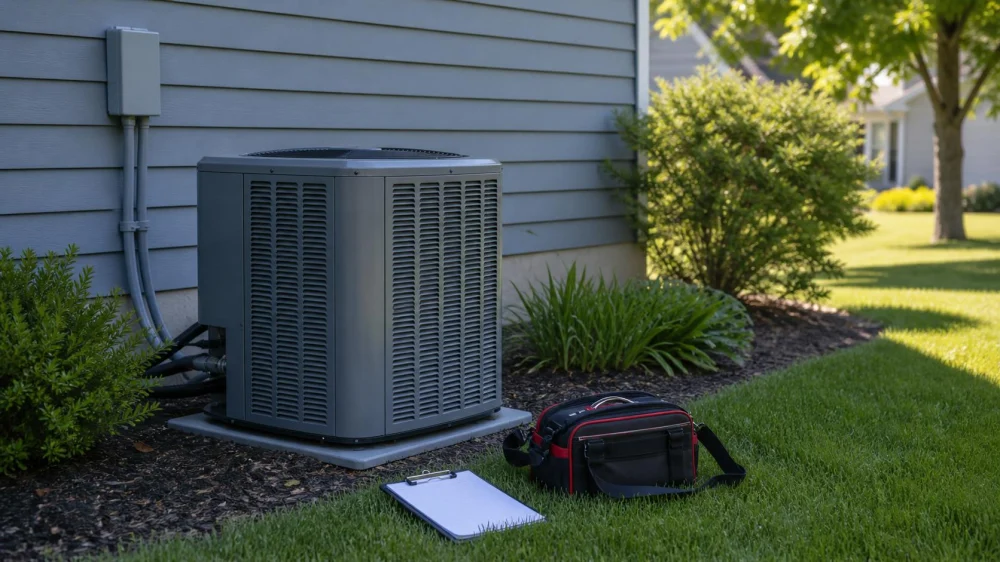
AC Buzzing Sound: Know When to Shut the System Down
On this page
Quick answer
A new electrical buzz from an air conditioner can come from a contactor, relay, motor, transformer, loose panel, refrigerant component, or debris, and it cannot be diagnosed safely by sound alone. Turn cooling off at the thermostat and call for service if buzzing is loud, continuous, worsening, paired with failed starting, or accompanied by heat, burning odour, smoke, sparks, repeated breaker trips, or abnormal vibration.
Do not remove service panels, touch capacitors, push a contactor, reach through a grille, or repeatedly restart the system. HVAC equipment can retain dangerous electrical energy after power is disconnected.
Metro Climate Heating & AC
ConcordAppomattox CountyVirginia
1295 Phoebe Pond Rd, Concord, VA 24538, USA
Stop immediately for these signs
- burning, melting-plastic, or sharp electrical odour;
- smoke, sparks, glowing, or hot wiring;
- a breaker or fuse that trips again;
- the outdoor fan is stopped while the unit hums or buzzes;
- severe vibration, grinding, or metal contact;
- water near electrical components; or
- the sound begins after storm, flood, or electrical damage.
Use emergency services for fire or immediate danger. Do not approach flooded or visibly damaged electrical equipment.

Above and Beyond RV Repair LLC
1275 Charles Golden Rd, Sparta, TN 38583, USA
Identify where the sound begins
From a safe distance, note whether the sound comes from the thermostat, indoor air handler, ceiling or wall grille, duct, outdoor disconnect, or condensing unit. Do not place your hand on equipment to feel vibration.
A brief normal relay sound differs from a sustained buzz. Record whether it begins when the thermostat calls, when the indoor fan starts, when the outdoor unit attempts to start, or after shutdown.
Record a useful pattern
- date, time, outdoor temperature, and thermostat mode;
- how long the sound lasts and whether it repeats;
- indoor fan and outdoor fan status;
- cool air at vents and any comfort change;
- odour, vibration, water, ice, or warning lights;
- recent outage, surge, storm, maintenance, or filter change; and
- a short video from a safe distance.
Do not provoke the sound repeatedly for a better recording.
Safe homeowner checks
Confirm the thermostat mode and setpoint, and check that supply and return grilles are open and unobstructed. View the filter without opening an electrical cabinet and replace it only according to equipment instructions.
Look from outside the outdoor unit for leaves or a loose object without reaching through the grille. Keep children and pets away. If the sound persists, shut the system down and arrange service.
What not to open or test
Do not open the disconnect, electrical panel, control compartment, air handler, or condenser cabinet. Never test voltage, bypass a switch, bridge thermostat wires, spin a fan with a stick, or replace a capacitor without training and proper procedures.
Do not reset a breaker more than once; repeated trips indicate a fault. Do not spray water or lubricant into the unit.
Prepare for HVAC service
Provide model and serial information from an accessible label, the symptom timeline, video, thermostat settings, maintenance history, and any breaker or outage event. Ask the technician to identify the failed component, contributing cause, electrical readings, parts and labour warranty, and whether other damage occurred.
Request written findings before authorising major replacement. A buzz can be a symptom, not the root cause.
Buzzing checklist
- Turn cooling off for new persistent buzzing.
- Use emergency help for fire or sparks.
- Observe location and timing from a distance.
- Do not restart repeatedly.
- Keep panels closed and hands outside grilles.
- Save model details and a safe short video.
- Use a qualified HVAC technician.
Frequently asked questions
Is a brief buzz normal?
Some controls make short sounds, but a new or sustained buzz deserves evaluation.
Can I push-start the outdoor fan?
No. That risks injury and equipment damage.
Should I reset the breaker?
One reset may follow the manual; never repeat it if the breaker trips again.
Can a dirty filter cause buzzing?
Airflow problems can strain equipment, but sound alone cannot identify the cause.
Can I keep using fan-only mode?
Ask a technician; it may be unsafe depending on the source.
What if the unit still cools?
Cooling does not prove the electrical or mechanical condition is safe.
Sources and evidence notes
The equipment installation, operation, and service manuals define normal sounds, shutdown steps, electrical isolation, and maintenance boundaries. Model-specific warnings take priority.
Electrical compartments and capacitors require qualified service. Local electrical and mechanical codes plus manufacturer procedures govern diagnosis and repair.
Conclusion and next steps
Stop cooling for a new persistent buzz, especially with heat, odour, failed starting, vibration, or breaker trouble. Record the timing from a safe distance, keep panels closed, and avoid repeated restarts or improvised tests. Give a qualified technician the equipment details and symptom record.
 Chickasaw Air Conditioning, Inc.4.0 (25 reviews)
 Wright's Air Conditioning and Heating, Inc4.0 (150 reviews)
 Swift Brothers Plumbing, Heating & Air4.0 (252 reviews)
 Dyess Air & Plumbing4.0 (1800 reviews)
 Renfrow Heating Cooling Plumbing & Electrical4.0 (124 reviews)
 Mechanical Specialty Systems0.0 (0 reviews)
 How to Handle an Air Conditioner Compressor Problem and Avoid Costly Repairs
 How to Review an AC Repair Invoice Before You File It
 How to Avoid the Most Common Air Conditioning Repair Mistakes for Homeowners
 The Ultimate Checklist to Fix Air Conditioning Leak Successfully in 2025
 Frozen AC Coil: Stop Cooling and Let the Ice Melt Safely
 Complete Guide: Cheap AC Fix for Homeowners in 2025