
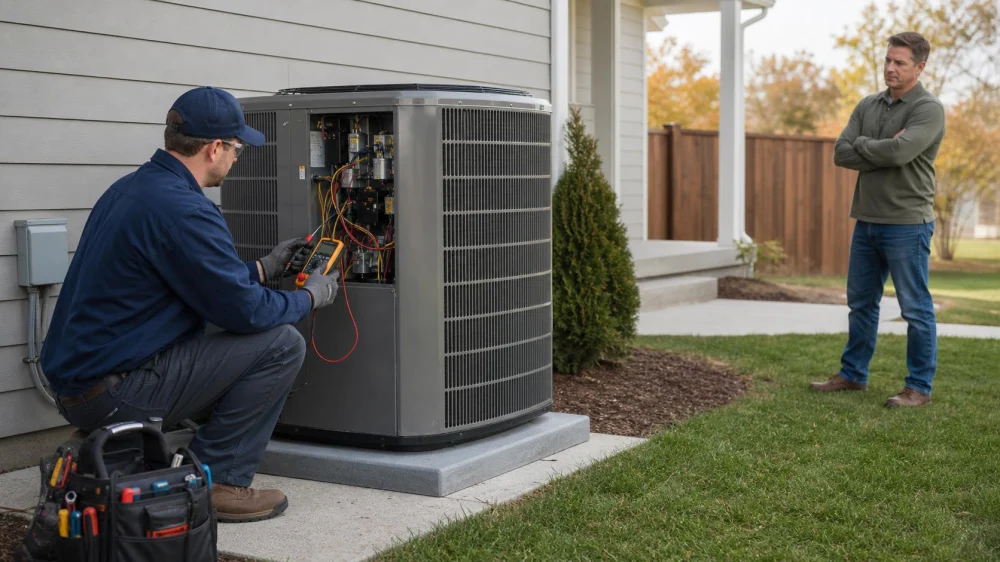
Suspected AC Contactor Failure: Record Symptoms, Leave Repairs to a Pro
On this page
Quick answer
A contactor is an electrically controlled switch used in many outdoor AC units. Chattering, buzzing, delayed starts, an outdoor unit that will not run, or a unit that will not stop can have several causes. Turn cooling off, keep clear of the cabinet and fan, record what happens, and call qualified HVAC service. Do not open the panel, press the contactor, bridge terminals, or replace parts based on appearance alone.

Alpha Energy Solutions
LouisvilleJefferson CountyKentucky
7200 Distribution Dr, Louisville, KY 40258, USA
Why it matters
Contactor symptoms overlap with thermostat, control-board, capacitor, wiring, safety-switch, compressor, and power-supply faults. The cabinet can contain hazardous voltage and stored electrical energy even when the thermostat is off.
This United States article provides general information, not electrical repair instructions. Equipment, disconnects, codes, service procedures, and warranties vary. Diagnosis and repair belong to qualified HVAC or electrical professionals.

Practical checklist
- Turn the thermostat to off if the outdoor unit behaves abnormally.
- Keep hands, tools, children, and pets away from the cabinet and fan.
- Record sounds, start and stop timing, thermostat display, indoor blower status, and any breaker trip.
- Note recent outages, storms, service, vegetation work, or pest activity without opening covers.
- Photograph model labels and the exterior condition from a safe position.
- Do not repeatedly reset a breaker or disconnect.
- Call for service promptly if the unit will not stop, smells hot, sparks, or trips protection.
Step-by-step plan
- Describe the sequence: thermostat call, indoor blower response, outdoor sound, fan motion, cooling result, and how the cycle ends.
- Shut cooling off and wait safely; do not reach through guards or touch refrigerant lines to diagnose.
- Check only normal user controls and obvious external obstructions while maintaining manufacturer clearances.
- Tell the technician about voltage events, prior components, nuisance trips, intermittent behavior, and whether the fault changes with temperature.
- Expect a full electrical and control diagnosis rather than an appearance-only part swap.
- Ask for measured findings, part identity, compatibility, root cause, price, and warranty before authorizing repair.
- After service, confirm normal start, run, stop, protection, cabinet closure, and documentation.
Save a short video from a safe distance, timestamps, thermostat settings, model and serial numbers, breaker events, service measurements, replaced-part details, invoice, and warranty terms.
Limits and warning signs
Pitted contacts or buzzing do not establish the only fault. Low control voltage, loose connections, a failing coil, pests, debris, capacitor or motor problems, and compressor demand can produce similar symptoms. Never infer de-energization from silence.
Use emergency help for fire, smoke, sparking, arcing, burning odour, damaged service conductors, or immediate danger. Keep clear and do not spray water on electrical equipment.
Frequently asked questions
Can I push the contactor closed?
No. This exposes you to hazardous voltage, can start moving equipment unexpectedly, and bypasses diagnosis.
Is buzzing proof the contactor is bad?
No. It is a useful symptom, but control voltage, wiring, debris, and other components must be checked.
Can I replace it with one that looks similar?
No. Ratings, coil voltage, poles, terminals, approvals, and equipment requirements must match.
Why will the outdoor unit not stop?
A welded contactor is one possibility, but controls and wiring also require qualified testing. Turn cooling off and seek service.
Sources and evidence
The guide follows common HVAC electrical safety: treat cabinets as energized, never defeat switching devices, document operating sequence, avoid repeated resets, and require measured diagnosis with compatible approved parts.
Conclusion and next steps
Switch cooling off, keep clear, and capture a short symptom record from a safe distance. Give the technician the equipment identity and timeline, then request measured findings and a documented repair before restart.
 Air Max N.W. Heating & Air Conditioning3.0 (3 reviews)
 EZ Heating & Cooling, LLC5.0 (110 reviews)
 William Crutchfield Enterprises Inc4.0 (44 reviews)
 Cygnature Heating & Air Inc4.0 (24 reviews)
 Call Dad4.0 (1372 reviews)
 Spartan Air Solutions4.0 (686 reviews)
 Ice on Your AC: Turn Off Cooling and Check Airflow First
 How to Clean Your Air Conditioner Ductwork to Improve Airflow
 Immediate Solutions for Fixing Your Wall Air Conditioner | AC Repair Guide
 How to Fix AC Unit Like a Pro: Expert Tips for Homeowners
 10 Signs It's Time to Replace Your Air Conditioning System
 Top Ways to Fix Your AC Unit Quickly and Affordably in Your Area