
AC Breaker Keeps Tripping: Stop Resetting and Call for Service
On this page
Quick answer
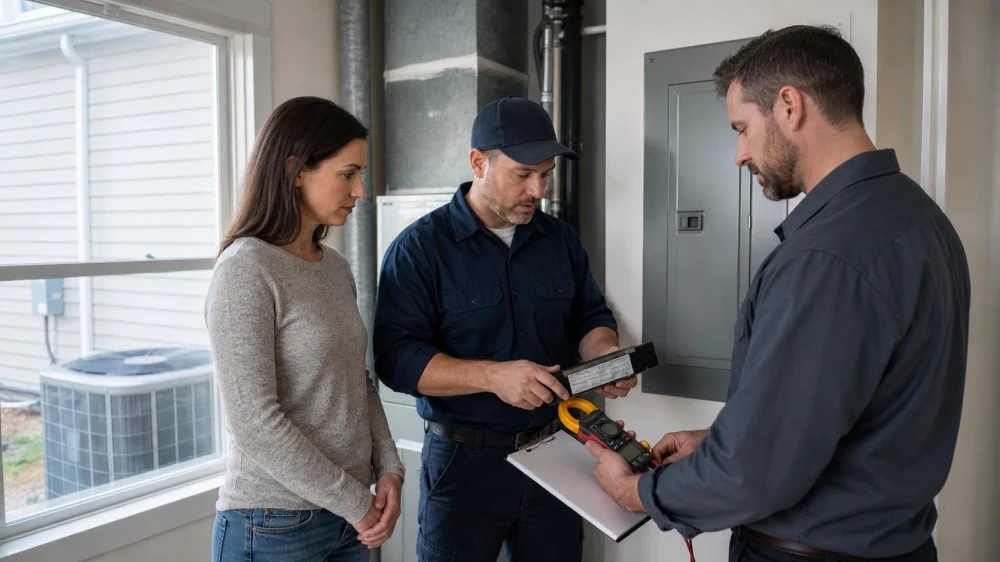
If an air conditioner circuit breaker trips repeatedly, turn cooling off at the thermostat and stop resetting the breaker. A trip can indicate an electrical fault, failing motor or compressor, damaged wiring, incorrect breaker, or another unsafe condition. Keep away from a hot, buzzing, sparking, wet, or burnt-smelling panel and call a qualified HVAC technician and licensed electrician as appropriate.
One reset after a known utility interruption may be allowed by the equipment instructions, but a second trip is diagnostic information—not permission to keep trying.
Texas Refrigeration & A/C Services LLC
18131 Quarry Vale Dr, Cypress, TX 77429, USA
Immediate response
- Set the thermostat system to Off without opening equipment.
- Keep people away from the outdoor unit, air handler, disconnect, and panel if heat, smoke, odor, sound, water, or visible damage is present.
- Do not touch the breaker or panel with wet hands or while standing on a damp floor.
- Call emergency services for fire, smoke, arcing, injury, or immediate danger.
- Use portable cooling, hydration, and a safer location for heat-vulnerable occupants while service is arranged.
Never hold a breaker on, tape it, replace it with a larger rating, insert a different fuse, bypass a disconnect, or run the system from an extension cord.

Airtech Heating & Cooling LLC - Clarksville Office
ClarksvilleJohnson CountyArkansas
1134 S Rogers St #9157, Clarksville, AR 72830, USA
Record useful clues
- Exact date and time of each trip
- Thermostat mode, setpoint, and room temperature
- Whether the indoor blower and outdoor fan started
- How many seconds or minutes the system ran
- Recent outage, surge, lightning, maintenance, construction, or water event
- Sounds, odors, visible ice, water, insects, debris, or damaged cable observed without touching
- Other circuits or appliances affected
- Equipment model, age, service history, and prior electrical work
Photograph the panel directory and breaker position from a safe distance. Do not remove the panel cover; live parts may remain energized even when a branch breaker is off.
Who should inspect
An HVAC technician can evaluate motors, compressor, capacitors, contactors, controls, airflow, refrigerant-side symptoms, and equipment wiring within scope. A licensed electrician can evaluate the breaker, conductor size, connections, disconnect, voltage, grounding, and panel condition. The contractors may need to coordinate rather than replacing parts by trial.
Ask for the measured fault or load, equipment nameplate data, circuit rating, identified cause, proposed correction, permits, and post-repair operating test in writing. A breaker that “tests fine” does not prove the connected equipment and wiring are safe.
Trip checklist
- Cooling switched off
- Breaker left tripped after repeat event
- Heat, smoke, odor, sound, water, and panel condition observed safely
- Trip timing and operating sequence recorded
- Recent outages and work noted
- Equipment and circuit identifiers gathered
- HVAC and electrical scopes coordinated
- Cause, measurements, repair, and test documented
- Vulnerable-occupant cooling plan active
Limitations
Breaker behaviour cannot diagnose the cause remotely. Panels contain dangerous energy and should be opened only by qualified people. Circuit requirements vary by equipment, code, and jurisdiction. This article is safety and service preparation, not electrical repair instruction.
FAQ
Can I reset it once?
Follow the equipment and electrical instructions after a known interruption. If it trips again or there are warning signs, stop.
Could a dirty filter trip the breaker?
Airflow problems can stress equipment, but do not assume they explain an electrical trip. Get a diagnosis.
Should I replace the breaker?
Not without qualified testing and correct ratings. A breaker may be responding to a downstream problem.
Can I run fan-only mode?
Ask the technician. The fan may share equipment or wiring involved in the fault.
Who should I call first?
If symptoms point to the AC equipment, call qualified HVAC service and disclose the breaker trip; panel or wiring concerns also require an electrician.
Evidence notes
CPSC home electrical guidance emphasizes correct fuse and breaker sizing and notes that compressor appliances can be damaged by repeated power interruption. OSHA and electrical-safety practice treat panels and energized parts as qualified-work areas. Use the equipment nameplate, manufacturer instructions, applicable code, and measured professional diagnosis as primary evidence.
Conclusion
A repeatedly tripping breaker is a protective action. Stop cooling, preserve the trip sequence, avoid panel work, protect occupants from heat, and require coordinated HVAC and electrical diagnosis before restart.
 Sears Appliance Repair4.0 (20 reviews)
 DJS Heating and Air Service4.0 (20 reviews)
 Stokley's Services Inc4.0 (42 reviews)
 Keith HVAC4.0 (10 reviews)
 R&R Environmental Mechanical AC & Heating4.0 (47 reviews)
 Premo Air4.0 (463 reviews)
 Avoid These Common Mistakes When Trying to Fix Air Conditioning
 How to Detect and Fix Water Leaks from Your Air Conditioning Unit
 How to Solve Electrical Issues in Your Air Conditioner Unit | Ac Fix
 How to Get Your AC Fixed Like a Pro: Expert Tips and Advice
 Can You Fix My AC Without Replacing the Entire System? Here’s What You Need to Know
 The Ultimate Checklist to AC Fix Successfully - Expert Guide for Troubleshooting